In recent weeks, as institutional flows back into the Bitcoin (BTC) market through investment products like ETFs, derivatives market data reveal a contrary trend: many retail traders are still betting on a decline in BTC prices.
This divergence not only reflects current market sentiment but could also serve as an early indicator of how capital will shift next — especially toward higher-risk assets, such as NFTs, which have historically reacted later in previous cycles.
This development suggests the market remains in a cautious state, as it remains unclear whether capital expansion has officially resumed.
Institutions buying, retail remains skeptical
After several weeks of witnessing capital outflows, the crypto market has begun to record the return of institutional money.
Aggregated data from Bitbo shows that spot Bitcoin ETFs have recorded over $3.28 billion in inflows since the beginning of March, reflecting a clear recovery in institutional funds after a period of correction.
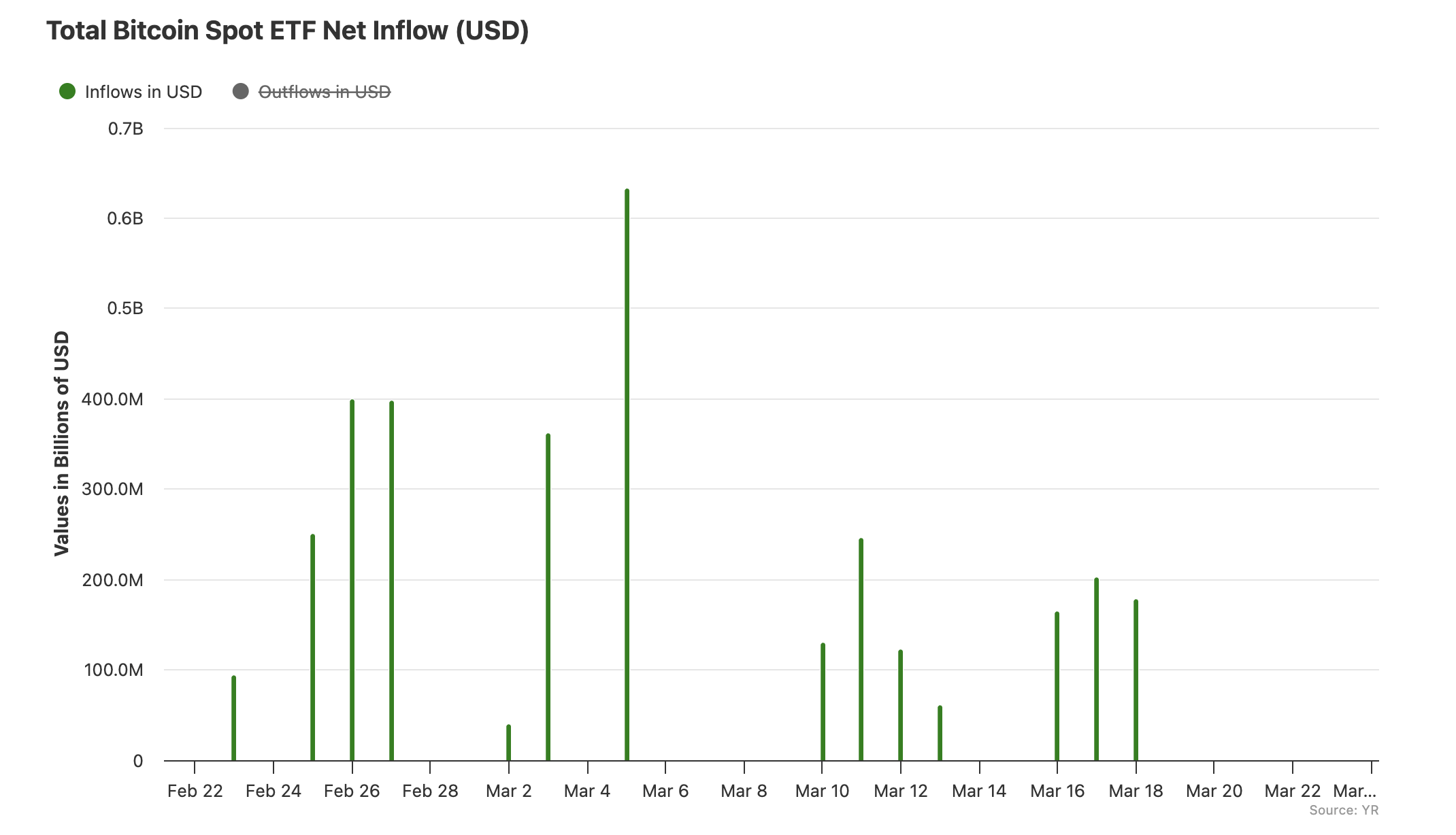
Total BTC spot ETF inflow in March. Source: BitBo
This flow primarily comes from indirect investment products, like ETFs, indicating renewed accumulation demand from institutional investors, while Bitcoin continues to fluctuate around the $70,000–$75,000 range.
Meanwhile, derivatives market data shows that retail trader positioning is leaning bearish in the short term.
According to data from Coinglass, Bitcoin funding rates have turned negative multiple times in March, indicating that short positions have outnumbered longs on major exchanges.
Additionally, open interest remains high while price action moves sideways. This phenomenon typically occurs during periods of market indecision (lack of conviction), where investors remain engaged with leverage but have not clearly leaned toward a specific trend.
NFTs remain “on the sidelines” of the recovery
While Bitcoin maintains its high price range, the NFT market has yet to show signs of keeping pace.
Data from Coingecko, on price movements over the past 7 days shows that the top NFT collections have largely continued to see their floor prices drop, with CryptoPunks being the sole exception, showing an insignificant increase:
- CryptoPunks: +1.4%
- Bored Ape Yacht Club: -4.6%
- Pudgy Penguins: -4.7%
- Mutant Ape Yacht Club: -4.0%
This volatility indicates that the NFT market remains in a bleak state, with little speculative capital appearing and no signs of money flowing back into this sector.
Liquidity reflects a similar picture. According to aggregated data from The Block, total NFT trading volume across the entire market reached only about $31M in the last 7 days, while 30-day volume fluctuated around $147M.

The weekly trade volume of NFTs by chain. Source: The Block
While not yet weakening to an alarming level, these figures show no signs of a comeback, reflecting a market still waiting for liquidity.
In previous cycles, NFTs have typically been a late-reacting asset class compared to Bitcoin and altcoins, moving only when liquidity begins to rotate and investor risk appetite increases. At present, data suggests this process has not yet truly begun.
What the Divergence Tells NFT Collectors
For NFT collectors, the current divergence can be viewed as an early signal of potential capital returning to this market, though no clear confirmation exists.
In past cycles, capital in the crypto market has tended to shift from Bitcoin to higher-risk assets as liquidity expands. This makes NFTs — considered high-beta assets — typically react later than BTC and altcoins.
Currently, data shows the NFT market has not had any positive reaction to signals from Bitcoin capital flows. Liquidity remains limited, trading volume has not recovered significantly, and most blue-chip collections are still trading within a narrow range. This indicates that speculative capital has not yet truly returned to this segment.
However, if Bitcoin maintains its trend and the divergence between institutional and retail flows is resolved positively, NFTs could enter a late-response phase — similar to previous cycles when liquidity began to spill over into higher-risk assets.
Nevertheless, this scenario heavily depends on general market liquidity conditions. Should Bitcoin weaken or institutional flows fail to maintain accumulation momentum, it could be difficult for segments like NFTs to attract liquidity afterward.
Besides liquidity factors, leading narratives such as GameFi — which played a key role in attracting capital to NFTs in previous cycles — have also shown no signs of returning, helping to explain why the market still lacks clear growth momentum.
Where liquidity flows next
Historically, the divergence between institutional flows and derivatives market positioning rarely lasts long. Following such periods, the market usually enters a phase of higher volatility as previously accumulated positions begin to be reflected in the price.
At this point, the NFT market shows no clear signs of a comeback, given that this divergence has only been occurring for a few weeks. For NFT collectors, signals from ETF flows, funding rates, and derivatives positioning continue to be noteworthy indicators as the market watches whether capital will truly rotate into higher-risk assets like NFTs.