For investors exploring decentralized finance, what is Centrifuge (CFG) is a common question as more attention shifts toward bringing real-world tangible assets into blockchain-based finance. Centrifuge is a project that connects traditional finance with DeFi by enabling assets such as invoices, real estate, and loans to be tokenized and funded on-chain.
This guide explains how the Centrifuge protocol works, the role of the centrifuge token, the problems it solves, and how both businesses and investors benefit from using it.
What Is Centrifuge (CFG)?
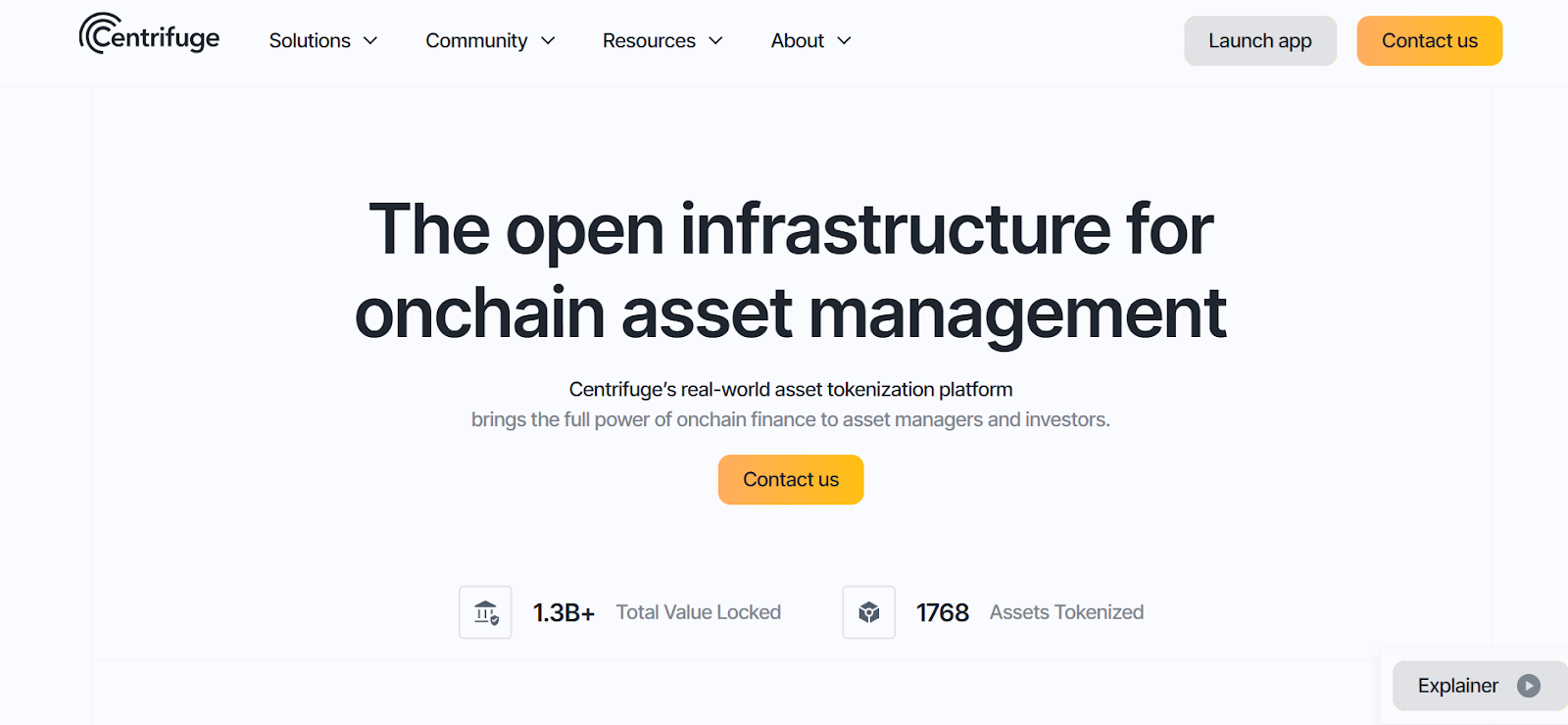
Centrifuge (CFG) is a blockchain project designed to bring real-world assets into decentralized finance. It allows businesses to convert assets such as invoices, mortgages, and royalties into digital tokens that can be financed on blockchain-based platforms.
Rather than going through banks or traditional lenders, companies can access funding directly from investors in the DeFi ecosystem.
At its core, the Centrifuge protocol acts as a bridge between traditional finance and blockchain. It enables asset originator businesses to unlock liquidity from assets that are usually slow or difficult to finance.
For example, a company waiting 60 days for invoice payments can use Centrifuge to access funds almost immediately by tokenizing that invoice and offering it to investors.
Who Built a Centrifuge?
Centrifuge was founded in 2017 by a German team led by Lucas Vogelsang (CEO) and Martin Quensel (COO), both with strong backgrounds in fintech and supply chain finance. They previously worked at Taulia, where they focused on improving access to working capital for businesses.
Along with contributors like Markus Ament and Philip Stehlik, the Centrifuge team built the protocol to connect real-world assets with decentralized finance and help businesses unlock funding more efficiently. Its CEO, Bhaji Illuminati, has positioned the project as the infrastructure layer that will power the next phase of institutional DeFi.
How Does Centrifuge Work?
Centrifuge connects businesses that need funding with investors who want to earn returns. It does this by turning real-world assets into digital tokens that can be financed on blockchain networks.
Businesses
Businesses, also known as asset originators, use Centrifuge to tokenize their off chain assets. These assets can include:
- Invoices
- Loans
- Real estate
- Royalties
Once tokenized, these assets are added to the centrifuge chain, where they can be accessed by investors. This process allows businesses to:
- Unlock cash tied up in assets
- Access funding faster
- Avoid traditional banking processes
For many asset originator businesses, this means improved cash flow and more flexibility.
Investors
Investors deposit stablecoins, most commonly USDT and USDC, into an asset pool and earn a yield that reflects the real-world interest rate on the underlying assets. Each pool is typically structured into two layers, similar to how traditional structured finance works:
- The senior tranche, which offers a lower but more stable, predictable return. It carries the first claim on repayments.
- The junior tranche, which offers a higher potential yield but absorbs the first losses if any borrower defaults. It acts as a protective buffer for senior investors.
Investors choose which tranche suits their risk appetite before committing capital.
Centrifuge Technology Overview
Centrifuge combines several layers to bring real-world off chain assets into DeFi:
- Centrifuge Chain: A purpose-built blockchain, now EVM-native, handling tokenization, crypto staking, and governance with fast, low-cost transactions.
- Tinlake: An Ethereum-based dApp where businesses mint NFTs of assets like invoices and use them to access funding through pools.
- Liquidity pools: Investors fund pools with different risk levels—TIN for higher returns, DROP for more stable yields—across multiple chains.
- P2P network: A privacy layer that verifies sensitive financial data off-chain while anchoring proof on-chain.
- V3 & multichain support: Operates across chains like Ethereum, Arbitrum, Avalanche, and Base, with Wormhole enabling seamless cross-chain liquidity.
These layers make it easier for businesses to unlock capital and for investors to earn transparent, real-world yield.
What Problems Does Centrifuge Solve?
Centrifuge tackles key challenges that limit access to financing for businesses and stability for DeFi investors.
- High costs and inefficiency: Traditional financing relies on banks and intermediaries, making it slow and expensive. Centrifuge uses NFT smart contracts via Tinlake to streamline lending and reduce costs.
- Limited liquidity of real-world assets: Assets like invoices can take weeks to settle. Centrifuge tokenizes them into NFTs, allowing businesses to access funds quickly.
- Restricted access to credit: SMEs often struggle to secure loans. Centrifuge opens liquidity pools where investors fund assets directly.
- DeFi volatility: Most platforms depend on volatile crypto collateral. Centrifuge introduces real-world income streams for more stable yields.
- Data privacy concerns: Sensitive financial data can’t be fully public. Centrifuge enables off-chain verification while anchoring proof on-chain.
What Is the CFG Token?
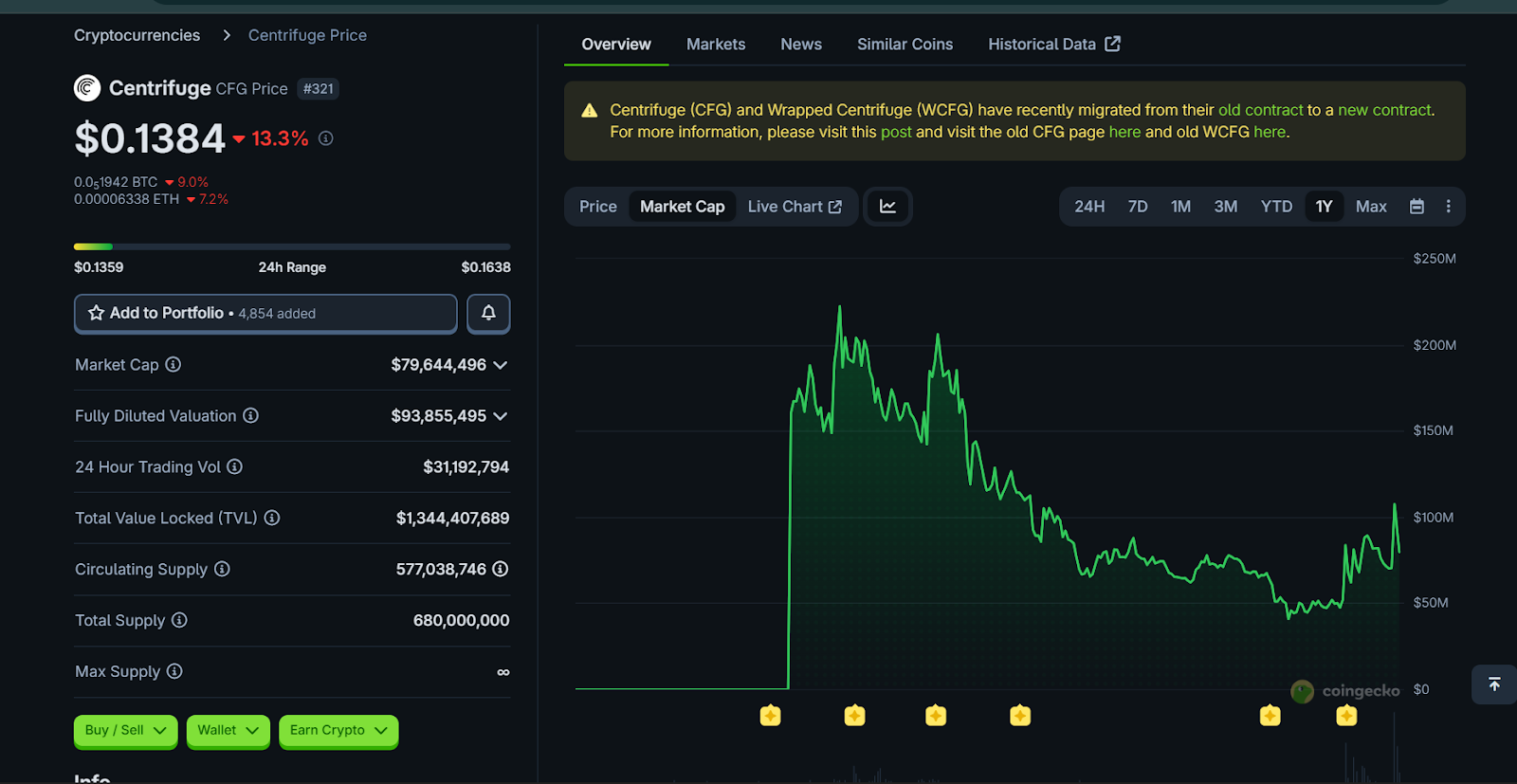
The CFG token is the main coin that powers Centrifuge. It is used to pay small platform fees, stake to help secure the network, and vote on important changes. Holding CFG lets you earn rewards and have a say in how the system improves.
CFG Token Utility and Use Cases
As of January 2026, the total supply is 691.8 million CFG tokens, with approximately 50% freely circulating. The remaining supply is split across:
- Team (14%): Vesting gradually through March 2030 to align incentives with long-term development.
- Ecosystem Incentives (24%): Locked for growth initiatives and protocol adoption, vesting linearly through April 2029.
- Incentives (12%): Tokens set aside to fund protocol growth, support partnerships, and develop the Centrifuge ecosystem, with a portion still locked and vesting through April 2029.
- Other Stakeholders (0.1%): Mostly vested; the small remainder vests over three months through March 2026.
CFG also carries a 3% annual inflation rate, with all newly minted tokens flowing to the Treasury rather than diluting stakers or validators. Staking rewards are therefore tied to network activity, ensuring a sustainable system.
The CFG token has several uses, including:
- Transaction fees: Used to pay for actions on the Centrifuge chain, creating ongoing demand from all participants.
- Governance: Allows holders to vote on pools and strategic decisions through the Centrifuge decentralized autonomous organization (DAO).
- Staking: Validators and nominators can stake tokens to secure the network and earn rewards.
- Collateral: Validators stake CFG as collateral for block production, with slashing penalties to encourage honest behavior.
How to Earn CFG Through Staking
Staking CFG works through a Nominated Proof of Stake (NPoS) model, the same system used by Polkadot. You do not need to run a node yourself to earn rewards. As a nominator, you simply select one or more validators you trust and delegate your CFG to them. When those validators produce blocks and earn rewards, you receive a proportional share of the rewards.
What Is Centrifuge Prime?
Centrifuge Prime is a service for large DeFi protocols and DAOs that want to put idle treasury assets to work in real-world assets. It lets them invest stablecoins or ETH into diversified pools of tokenized crypto assets, earning real yields while keeping everything auditable on-chain.
The platform is designed to meet governance and compliance standards, making it suitable for institutional participants. For example, Aave has used Centrifuge to integrate real-world asset collateral, and the $100 million JAAA strategy with Resolv in 2026 marked one of the largest RWA deployments in DeFi history.
Common Use Cases of Centrifuge
Centrifuge is already used across several real-world applications:
- Invoice financing: Businesses tokenize unpaid invoices to access working capital instantly, rather than waiting 30–90 days.
- Tokenized US Treasuries: Asset managers like Janus Henderson issue on-chain versions of Treasuries and CLOs, offering stable, real-world yield.
- Real estate loans: Lenders tokenize mortgage portfolios and tap DeFi liquidity as an alternative to traditional financing.
- DAO treasury management: Through Centrifuge Prime, DAOs deploy idle funds into RWA pools to earn more consistent returns.
- Private credit: Lending funds tokenize loan portfolios, giving DeFi investors access to markets usually out of reach.
- Tokenized index products: With S&P DJI, Centrifuge offers on-chain index exposure like the S&P 500 (SPXA).
The Future of Centrifuge
Centrifuge’s leadership sees 2026 as a turning point for real-world asset tokenization. The CEO predicts that by the end of the year, over half of the top 50 asset managers will have active tokenization strategies.
For Centrifuge, the roadmap includes expanding index product offerings through its S&P DJI partnership, deeper cross-chain integration via additional EVM deployments, and a growing white-label service for institutions using Centrifuge’s infrastructure under their own brand. The Treasury Advisory Group (TAG) is exploring fee-sharing and staking yield enhancements to strengthen CFG’s value as decentralized asset financing protocol revenues grow.
The long-term vision is for Centrifuge to become the go-to infrastructure for institutional real-world asset tokenization, essentially the Ethereum of RWA, providing the trusted rails that financial institutions rely on to bring assets on-chain.
Conclusion: Is CFG a Good Investment?
CFG makes a compelling case for investors who believe in the real-world asset tokenization thesis. After hitting a low of around $0.10 in February 2026, the token jumped roughly 95% following its Binance listing and now trades near $0.165—still far below its all-time high of $2.52 from October 2021. The Binance listing added credibility, and technical analysts note a cup-and-handle breakout pattern with a near-term target around $0.27.
Long-term potential is tied to Centrifuge’s fundamentals: projected revenue of $15 million by the end of 2026, fee-sharing mechanisms under review by the Treasury Advisory Group, and $1.37 billion in TVL, with institutional partners such as Janus Henderson and Aave actively participating. Before investing, review official documentation, understand the token unlock schedule, and assess your risk tolerance to avoid losing money.
FAQs
Centrifuge runs its own blockchain, the Centrifuge Chain, built specifically for tokenizing real-world assets. It was originally developed using Substrate and connected to the Polkadot ecosystem. Today, it also supports EVM-compatible chains, allowing broader DeFi integration across multiple networks.
CFG is the native token of Centrifuge, used for fees, staking, and governance within its ecosystem. DOT is the native token of Polkadot, which provides shared network security and interoperability for connected chains. CFG powers Centrifuge, while DOT powers the broader network it can connect to.
No, Centrifuge refers to the entire ecosystem, including apps, pools, and services like Tinlake and Centrifuge Prime. The Centrifuge Chain is the underlying blockchain that handles transactions, staking, and governance. Think of the chain as the engine, and Centrifuge as the full platform built around it.
CFG is used to pay transaction fees across the Centrifuge Chain, creating consistent demand. It can also be staked to help secure the network and earn rewards as a validator or nominator. As a CFG holder, you can use the token to vote on governance decisions that shape the protocol’s future.