A study from the White House, released on April 8, may have shifted the landscape of the debate surrounding the CLARITY Act, just before the Unite State (U.S.) Senate enters a critical review phase later this month, while XRP is trading around $1.33.
The report argues that banning stablecoin yields offers almost no significant benefit to the banking system, which could help remove a major hurdle for the CLARITY Act—an element the market assesses as having the potential to dictate XRP’s next trend.
The April Window That Could Move XRP
April 2026 is being viewed as a pivotal period for the CLARITY Act in the U.S. Senate.
Following the Easter break, which ends on April 13, the Senate Banking Committee, chaired by Tim Scott, is expected to conduct a discussion and markup session for the bill in the second half of this month. If progress goes smoothly, the bill could be brought to a full Senate vote as early as May.
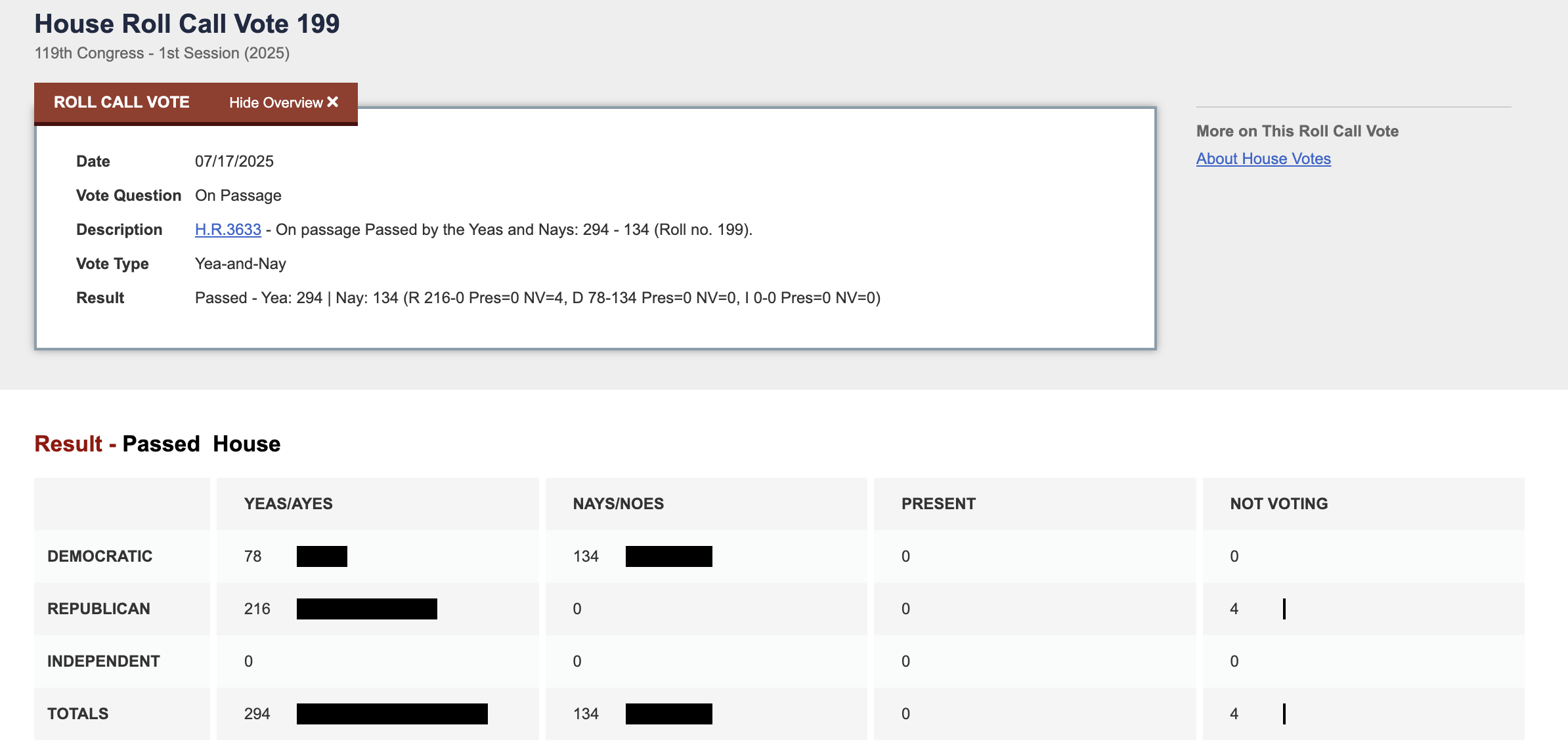
CLARITY Act House Vote Results in 07/2025. Source: Congress.gov
The bill was previously passed by the U.S. House of Representatives in July 2025 with a 294–134 vote, while a separate version was also passed by the Senate Agriculture Committee in January 2026. However, progress in the Senate has remained stalled as parties required more time to discuss various policy aspects.
Legislative experts warn that if the CLARITY Act does not clear the committee in April, the likelihood of it being signed into law in 2026 will drop sharply, as the U.S. Congress prepares to enter the midterm election cycle. This makes the “April window” a decisive moment.
A Key Obstacle May Be Fading
The biggest obstacle to the CLARITY Act is believed to be the conflict of interest between the traditional banking industry and the crypto industry regarding stablecoin yields.
Banks fear that allowing interest-bearing stablecoins will erode deposits, while crypto companies argue this is a necessary feature for competition and expanding applications.
However, a recent 21-page report from the The Council of Economic Advisers (CEA) released on April 8 provided notable conclusions. The report suggests that banning stablecoin yields would only increase total bank lending by approximately $2.1 billion (equivalent to 0.02%), an insignificant level for the overall financial system. Conversely, such a ban could cause a welfare loss of about $800 million for consumers due to the loss of profitable investment options.
The research team also emphasized that the majority of stablecoin reserve assets remain within the banking system or U.S. Treasury bonds; therefore, concerns regarding capital outflows from banks are unfounded.
Additionally, a deal is gradually taking shape in the Senate. Previously, Senators Thom Tillis and Angela Alsobrooks reached a preliminary consensus, proposing a ban on passive yields while still allowing rewards linked to the use of stablecoins in payments.
Why This Matters for XRP
The CLARITY Act is not just a bill on market structure; it could also shape how digital assets are classified between the U.S. Securities and Exchange Commission (SEC) and the Commodity Futures Trading Commission (CFTC).
For XRP, this is particularly important. After years of being entangled in legal disputes with the SEC, XRP has recently seen signals of being viewed as a “digital commodity” in coordination frameworks between the two regulatory agencies in March 2026.
If the CLARITY Act is passed, it could formalize this classification, thereby removing much of the “regulatory overhang”—the factor that has stifled participation from major financial institutions in XRP.
In this context, XRP is considered one of the most sensitive assets to the bill’s outcome, as its direction is directly tied to how the U.S. defines the boundaries between securities and commodities in the crypto market.
XRP Price Outlook Hinges on a Binary Outcome
XRP’s short-term price outlook is heavily dependent on the results of the CLARITY Act.
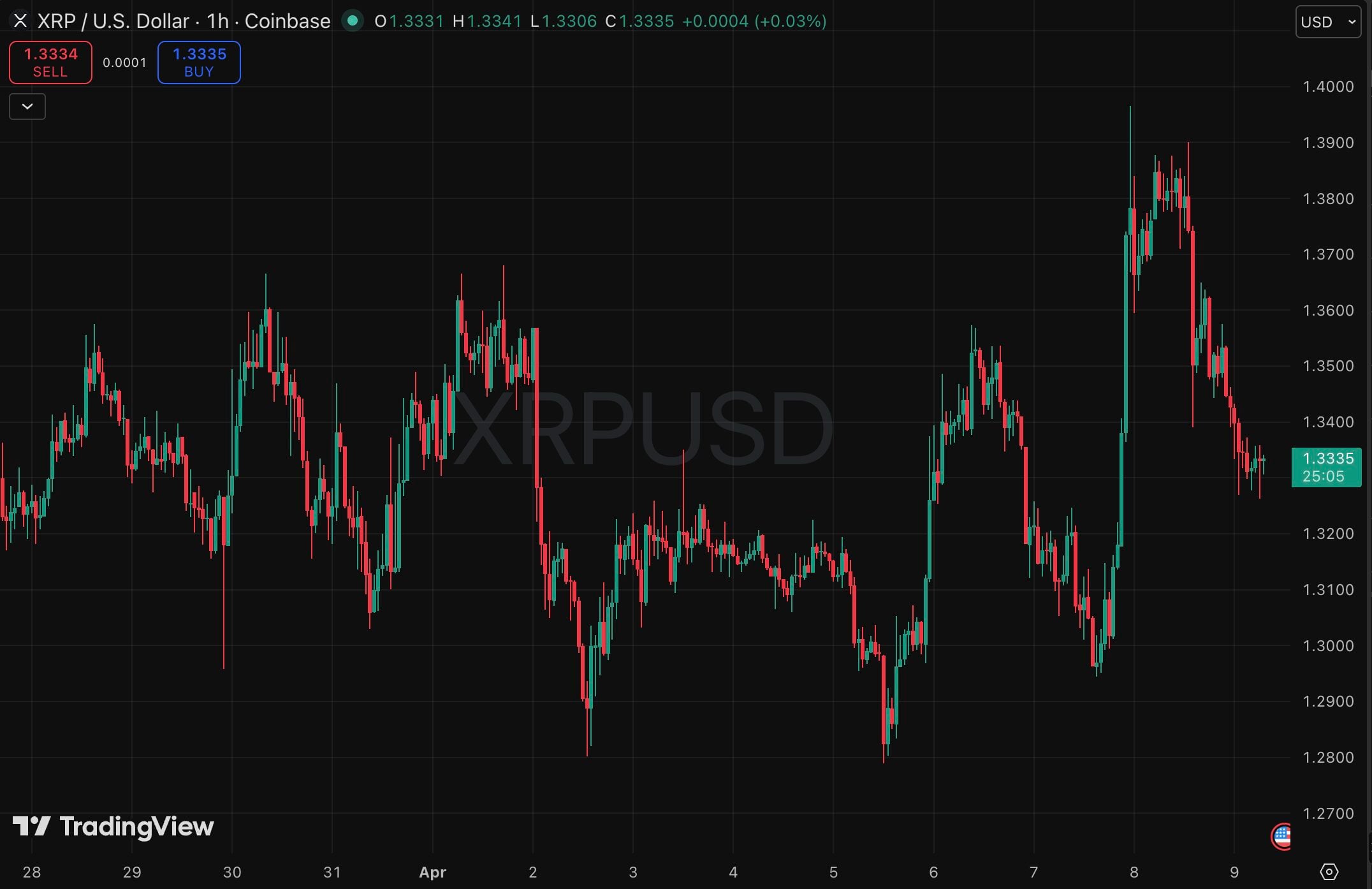
XRP price chart (1H). Source: TradingView
Bull case: Regulatory clarity unlocks capital
If the bill passes the Senate, the market may view this as a clear confirmation of XRP’s legal status in the U.S.
In this scenario, institutional capital inflows could increase significantly, especially if expectations for an ETF or XRP-related financial products are bolstered. Some market estimates suggest that billions of dollars in cash flow could be “unlocked” once regulatory barriers are removed.
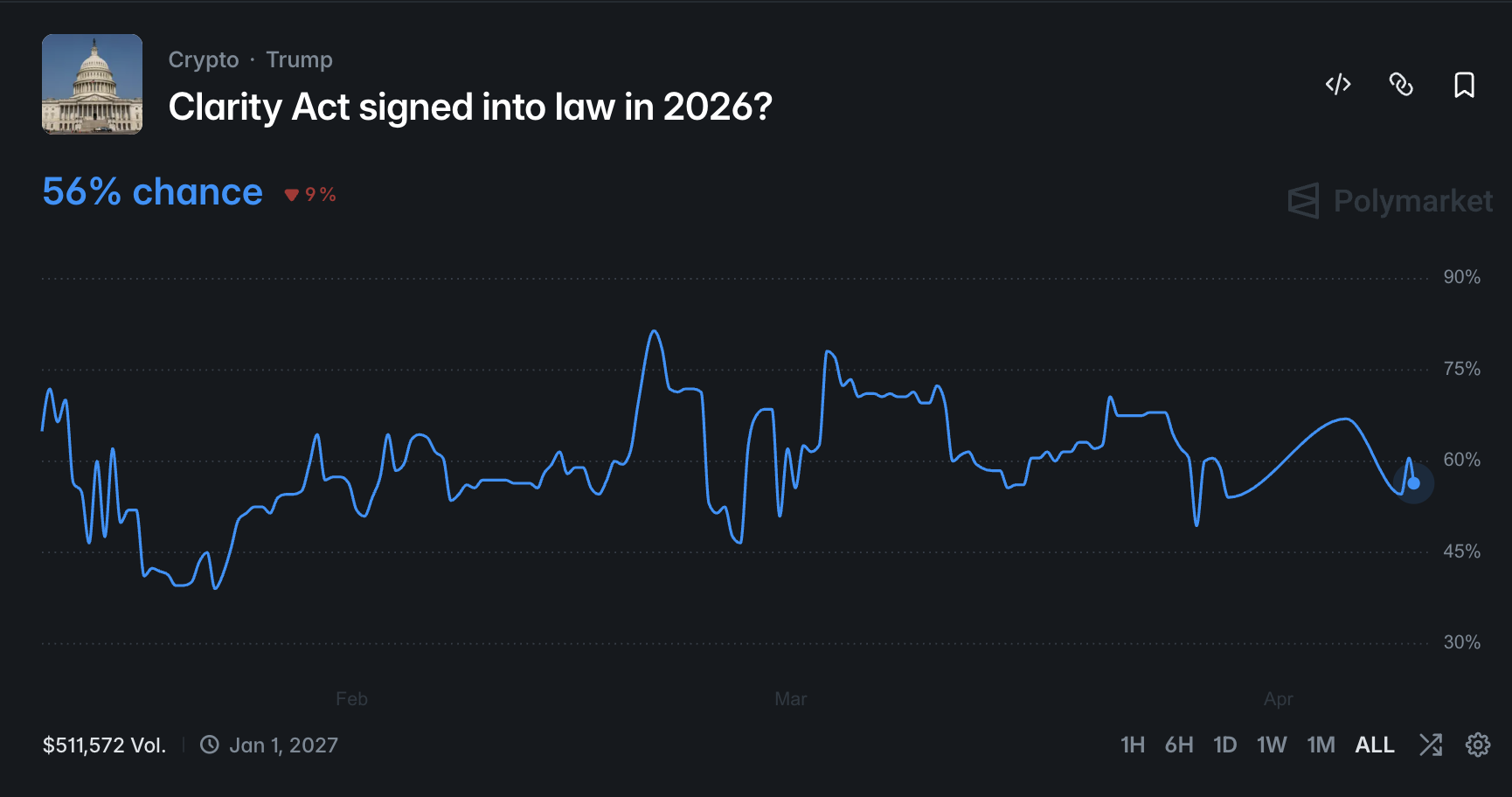
Clarity Act signed into law in 2026. Source: Polymarket
The price of XRP could then recover to the $1.60–$1.80 range in the short term, based on the re-pricing of the asset according to lower risk levels. Data from the prediction platform Polymarket currently shows the probability of the bill passing in 2026 hovering around 56-70%, reflecting relatively positive market expectations.
Bear case: Delays extend uncertainty
Conversely, if the CLARITY Act continues to be delayed or fails to pass the Banking Committee in April, a negative scenario could unfold.
The lack of legal clarity will continue to keep large institutions on the sidelines, while weakening market sentiment could pull the XRP price down to the $1.20 range or lower, potentially even toward $0.80 if selling pressure intensifies.
Therefore, if the bill is not pushed forward before the summer, the likelihood of it being delayed until the next legislative cycle is very high due to the influence of the midterm elections.
What Comes Next for XRP
In the coming weeks, market attention is focused on the progress of the CLARITY Act in the U.S. Senate, particularly the markup session expected to take place after April 13.
Congress has spent the better part of half a decade trying to pass a framework to onshore the future of finance.
It is time for @BankingGOP to hold a markup and send the CLARITY Act to President Trump’s desk.
Senate time is precious, and now is the time to act.
— Treasury Secretary Scott Bessent (@SecScottBessent) April 9, 2026
Beyond legislative developments, signals from the White House and the Treasury Department are also playing a major role. Treasury Secretary Scott Bessent has recently repeatedly emphasized the necessity of the bill to bring “stability and peace of mind” to the market, while viewing stablecoins as a strategic tool to strengthen the position of the USD.
Intermediaries such as Coinbase are reportedly working toward a deal on the stablecoin yield issue, indicating that the potential for political consensus is growing.
At this point, XRP’s price movement may depend less on technical factors or market cycles and more on how Washington resolves internal conflicts over crypto regulation.
If the CLARITY Act clears its final hurdle in April, XRP could enter a new phase with higher adoption from institutions. Conversely, any delay could prolong the state of uncertainty—a factor to which the market typically responds by pricing in higher risk.