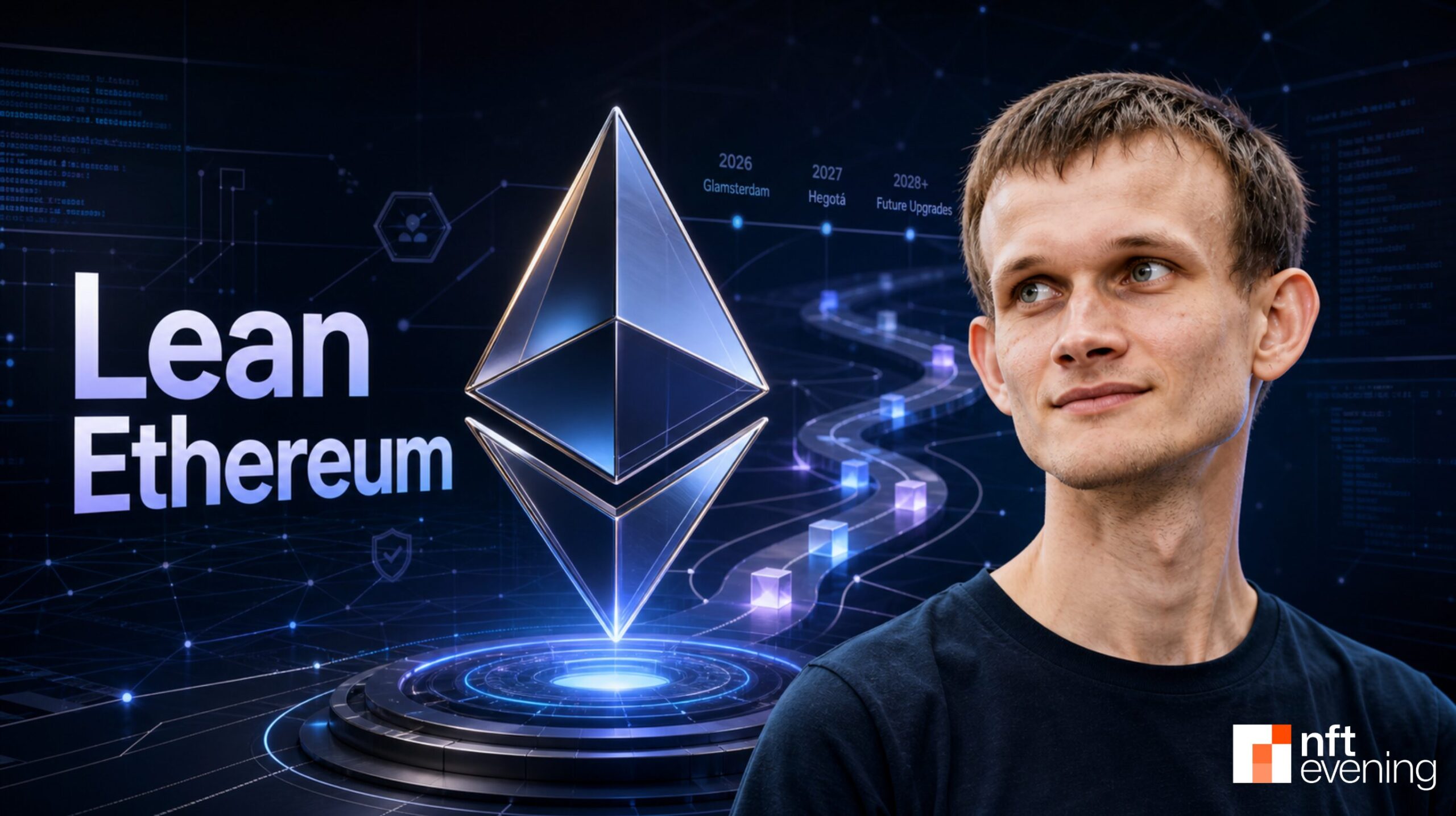
On July 6, 2026, Vitalik Buterin published further details on the “Lean Ethereum” direction in a new series of updates to the Ethereum community, following recent discussions between researchers and client teams. The proposal focuses on making the consensus layer lighter, easier to upgrade, and more aligned with long-term goals such as privacy and post-quantum security. Although it is not yet a finalized hard fork, this content indicates that Ethereum is expanding its L1 roadmap to reduce protocol complexity over the coming years.
What Happened
On July 6, 2026, Buterin shared an updated strawmap of Ethereum L1, stating that this document follows recent discussions among Ethereum researchers in Berlin and client teams in Svalbard. The strawmap places Lean Ethereum on a multi-year trajectory, with long-term goals including a fast L1, a post-quantum L1, and a private L1.
Two weeks ago, Ethereum researchers met in Berlin to continue charting the protocol’s long-term trajectory, following along discussions with client teams in Svalbard in April.
The updated strawmap is at https://t.co/HZEerH1xxI, and I attached a picture of it to this post.
My… pic.twitter.com/KPGayHSySf
— vitalik.eth (@VitalikButerin) July 4, 2026
In a follow-up update, Buterin dove deeper into the consensus branch of the roadmap, questioning how Lean Ethereum could become “aggressively more lean” while adding stronger validator privacy. The document titled “The Extremely Lean Chain” subsequently presented design directions for a lighter consensus chain, where Ethereum reduces the amount of data that must be maintained directly within the protocol and relies more heavily on cryptographic proofs.
Nevertheless, this remains a research proposal, not an announcement of a finalized hard fork deployment or protocol changes. This series of updates indicates that Lean Ethereum is being concretized from a long-term vision of a leaner, more private, and quantum-resistant L1 into technical directions that can be discussed, verified, and later introduced into the standardization process by the Ethereum community.
Inside The Proposal
Buterin targets a core part of the beacon chain: the amount of data the protocol must maintain for each validator. Currently, each validator in the consensus state is attached to multiple data fields, ranging from a 48-byte public key, 32-byte withdrawal credentials, and an 8-byte active balance to slashed status and epoch milestones related to activation, exit, and withdrawal. As the validator count grows, this state makes epoch processing heavier, especially if Ethereum wants to move toward few-slot or single-slot finality.
The “extremely lean” design proposes reducing the per-validator state to a 1-byte effective balance and a 5-byte pubkey index. The remaining data would be handled using proofs: validators monitor their own necessary data, prove whether they participated or did not participate in an attestation, calculate their new balance, and then submit that proof to the protocol.
In the initial description, Buterin used a one-day cycle for the balance update proof. Validators submitting proofs late would not be instantly slashed or excluded, but they cannot continue to attest until the update is complete. He also suggested that a one-hour cycle is the lower bound in terms of cost, while one day is a more conservative choice.
At a scale of 1 million validators, Buterin estimates the bitfield to be only around 128 kB, and the effective-balance tree around 1 MB. According to him, these structures can be proven using STARKs, but the proofs still need to be aggregated to avoid creating too much overhead for the protocol.
Privacy And Post-Quantum Angle
In addition to state reduction, Buterin’s proposal integrates validator privacy into the core design. In the next phase, the active validator registry could become a separate structure on a day-by-day basis. Validators would use a fresh pubkey every day, causing identities to be periodically re-anonymized rather than being tracked long-term through a fixed public key.
This design also aims to use ZK-STARKs so validators can prove their connection to a previous state without exposing their entire history. According to Buterin, this model could allow a validator identity to “re-randomize each day,” where only the validator itself knows the link between the old and new identity.
This proposal aligns with the post-quantum direction of Lean Ethereum. In an Ethereum Foundation blog post from July 2025, Justin Drake described Lean Ethereum as a 10-year vision that places hash-based cryptography at the center. The new strawmap also includes “post-quantum L1” and “private L1” among the long-term goals for Ethereum L1.
Roadmap Context
The strawmap on strawmap.org is maintained by EF Architecture and is described as a “strawman L1 roadmap,” not an official roadmap adopted by the entire Ethereum ecosystem. This document serves as a coordination tool for researchers, client developers, and governance participants, with a vision extending to the end of the decade.

Ethereum L1 strawmap. Source: Vitalik Buterin
According to ethereum.org, the closest upcoming upgrades, Glamsterdam and Hegotá, are both in the development phase, expected in H2 2026. Glamsterdam is currently tied to goals such as enshrined proposer-builder separation and block-level access lists. In the strawmap, longer-term upgrade directions are divided into three layers: consensus layer, data layer, and execution layer.
Lean Ethereum is therefore not a single upgrade, but a cluster of technical directions for L1. Lean consensus focuses on finality and a lighter beacon chain; lean data relates to data availability and blobs, while lean execution aims for an execution environment that is more friendly to proving while maintaining continuity with the EVM ecosystem.
What Comes Next
Buterin’s proposals will need to be researched, critiqued, and refined by the Ethereum community before they can enter the standardization process. Open questions include the actual proof costs for small validators, the ability to aggregate proofs at scale, the impact of validator anonymity on measuring decentralization, and how to handle slashing in a model where pubkeys change daily.
If The Merge in 2022 transitioned Ethereum from proof-of-work to proof-of-stake, Lean Ethereum focuses on a different layer of change: making L1 lighter, easier to verify, more private, and readier for post-quantum cryptography. The next steps will likely unfold through research discussions, EIPs, client implementations, testnets, and, finally, a hard fork.