Cryptocurrency exchanges have come a long way from being simple order-matching engines. From integrating AI/ML to becoming a foundational layer for powering payments, remittances, or tokenization, they’re evolving into full-scale modern financial infrastructure. The multi-functional approach helps exchanges scale their growth by 10X.
If you’re planning to launch the best cryptocurrency exchange software for 2026 and beyond, these are trends that you must chase.
1. Composable Architectures
Monolithic exchange stacks no longer work. When every upgrade or compliance update requires a complete system overhaul, agility dies, and so does the reputation of exchanges.
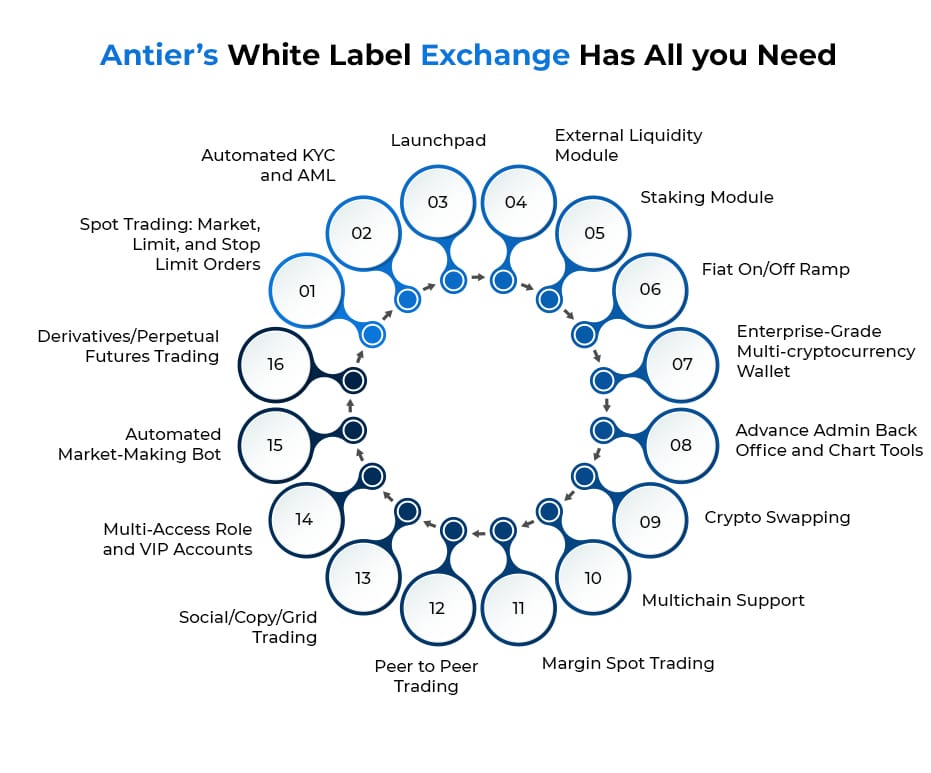
Antier’s white-label crypto exchange enables exchanges to evolve in real time, making swaps, upgrades, and component expansions easier. Each part of the system, including trading engines, staking, copy trading bots, wallets, compliance modules, etc., operates as an independent module within a fully modular architecture.
Businesses leveraging Antier’s white label cryptocurrency exchange can, therefore, seamlessly:
- Add new features and modules
- Adapt KYC or custody logic to meet jurisdictional changes instantly
Upgrades basically become incremental, not overhauls. This architecture slashes maintenance downtime by up to 40% and lowers development costs. This ultimately translates to faster feature rollouts and uninterrupted trading revenue.
2. Exchanges as Payment and Remittance Hubs
As discussed earlier, exchanges are no longer the spot trading engines that depend upon transaction fees for their sole revenue source. The new generation of cryptocurrency exchange software is a financial highway bridging modern finance with TradFi.
Stablecoins facilitated $46 trillion in transactions in the very first year of their mainstream hype. Exchanges that won’t advocate digital assets in the traditional financial workflows will struggle to survive the intense, cut-throat competition that’s rapidly approaching.
Antier’s white label cryptocurrency exchange comes with a P2P exchange module, making it ideal for cross-border remittances and peer-driven settlements. Its fiat on/off ramps can also enable exchanges to facilitate everyday digital asset payments. So, it already has the backend to transform crypto exchanges into a payment and remittance engine. Businesses just need to develop a user-friendly remittance frontend and a merchant-facing dashboard for payments to expand and diversify their revenue streams.
Each transaction and transfer will become a revenue touchpoint. Exchanges earn from merchant fees, remittance margins, and settlement API usage (with x402 integration).
3. Hybrid Trading Venues
The share of decentralized exchanges in spot trading volumes has been increasing consistently over the past few years. While CEXs still dominate the crypto exchange market with unmatched speed and liquidity, both ecosystems are advancing in different directions and serving distinct user segments. In 2025 Q3, perpetual trading volumes on DEXs reached an ATH of $1.8T, whereas spot trading volumes on CEXs hit $5.1T over the same period.
However, it’s no more about DEX vs CEX. Hybrid models that combine the strengths of those and overcome each other’s inefficiencies are taking over.
Antier’s hybrid architectures merge the speed and liquidity of CEXs with the transparency and trust of DEXs, with hybrids that blend on-chain custody with off-chain execution and off-chain order book and on-chain settlement. Businesses can also build custom decentralized custody with verifiable reserves or hybrids that enable regulatory auditability without sacrificing execution speed.
These models improve user trust and retention. Exchanges adopting hybrid architectures report 20–35% lower withdrawal churn and up to 25% higher daily locked liquidity. With more liquidity staying on-platform, fee revenues can rise by 15–20%, even without increasing user count.
3. Multi-market Reach and Cross-Chain Liquidity
In 2026 or beyond, if your cryptocurrency exchange software doesn’t let people reach multiple markets and chains under a single roof, it is already behind the curve. Stocks, commodities, carbon credits, etc., are all entering the same order book as Bitcoin. And not just this, top-notch trading platforms like Robinhood are also bringing stocks, forex, and crypto together in one experience.
Antier’s custom multi-asset crypto exchange development frameworks deliver this capacity through a unified architecture that supports:
- Spot, futures, and perpetual derivatives
- Cross-margin logic spanning assets and markets
- On-chain liquidation and funding systems
- Cross-chain liquidity and unified collateral management via a single-margin account
- Real-time internal bridging for low-latency movement of assets across chains
- A unified risk engine managing exposure across ecosystems
- Tokenized RWAs and NFTs (also add Fiat RWA ramps to onboard the next wave of users)
Crypto exchange software implementing cross-chain, multi-asset systems expands their addressable trading market by 2-3x, as then they can onboard new asset classes fast. These multi-asset and chain trading venues also slash liquidation disputes and annual errors by up to 90% and improve trader confidence and retention, leading to 20-25% higher active trading volumes.
4. AI-Native Crypto Exchange Development
AI will no longer be a top-up layer on cryptocurrency exchange software. It will be natively built inside various modules, enhancing their efficiency and utility. Crypto exchange developers who think like AI can create exchanges where automation doesn’t feel like a complexity or an extra feature.
Antier recently rolled out plug-and-play AI modules for crypto exchange development. Their experienced developers have also delivered crypto exchanges built with AI in the tech stack, enabling smart order routing, real-time risk detection, and adaptive UX with personalized dashboards and voice-based trade assistants. X402 integration further helps exchanges to prepare for an economy where not just humans but AI assistants will trade and transact.
AI-driven execution can cut trade slippage by 10-30 bps per trade, translating to millions in retained user value and higher trading volume. Platforms using AI-led risk monitoring typically see 40% fewer manual reviews and 25% lower compliance costs. Overall, AI-native stacks have shown 8-12% higher profitability per active trader.
5. Security, the Never Dying Trend
Cryptosphere has expanded with digital assets reaching more than 715 million users now. And with every technological leap and layer, new vectors of risk. While innovation grabs the headlines, security remains the non-negotiable backbone of the platform that survives beyond the hype cycle.
Antier builds every custom and white label cryptocurrency exchange development solution with multi-layered security frameworks, including:
- MPC and multi-sig custody to eliminate single points of failure.
- On-chain proof-of-reserve protocols ensuring verifiable asset backing.
- AI-powered anomaly and fraud detection for real-time threat prevention.
- Continuous smart contract audits and formal verification for all deployed modules.
- DID-based authentication and session security for end-user trust.
Robust security architecture reduces fraud and loss incidents by 90%, cuts recovery and downtime costs by up to 70%, and directly strengthens brand credibility, lifting institutional onboarding by 25–30%.
6. Web2-like Experience on Web3 Exchanges
Gas fees, signature fatigue, and complicated trading processes are the roadblocks deterring user experience, keeping the next wave of users out. MEV is another issue that shakes users’ trust in decentralized exchanges.
Antier specializes in MEV-resistant gasless crypto exchange development. They have also built Hyperliquid-like decentralized exchanges with meta transactions that enable users to execute transactions in a single session. Intent-based DEX development brings next-level convenience with traders using natural language prompts or single-tap commands while solvers handle routing, approvals, and execution.
Implementing these mechanisms eliminates fee friction, increasing trade completions by 35–50% and reducing user drop-off by up to 60% during onboarding. Overall, they can drive 15–20% higher daily fee revenue from more active traders.
Launch your 10X growth-ready exchange with Antier today.
7. Compliance-First Cryptocurrency Exchange Development
After President Trump’s triumph, laws and regulations associated with crypto and crypto platforms have been changing fast around the world. As the regulatory clarity approaches every country gradually, it is essential for exchanges to bake compliance modules into the foundations.
Antier leads as a compliance-first crypto exchange development company offering MiCA, VARA, and SEC-ready white label crypto exchanges. Even if you’re planning to launch in Singapore, Australia, or other jurisdictions, their white label exchanges with modular compliance add-ons help you launch confidently.
Automating compliance tasks can reduce operational overhead by 30–40%. Audit-ready systems accelerate institutional onboarding, shortening deal cycles by up to 50%. For high-volume exchanges, that can mean $200K–$500K annual savings on compliance staffing and manual audit processes.
8. The Superapp Era
Crypto superapps were among the highlights in Token 2049, the largest crypto event of 2025. The single-use apps are slowly fading or turning into comprehensive ecosystems, and that’s the need of the hour. Tomorrow’s crypto exchanges will look like all-inclusive ecosystems where users can trade, stake, tokenize, lend, borrow, tokenize, process everyday payments, send money across borders, play games, or even socialize, all under one identity layer.
Antier’s white-label cryptocurrency exchange enables businesses to develop crypto superapps with multiple features. The ready-to-deploy trading platform allows you to launch your first draft of a superapp in just 7 days, and you can launch the rest in phases. One sign in, and the users can access their digital finance, engage with the community, and also play mini games, no need to jump between ten different apps.
Multi-vertical exchanges report 30–50% higher user retention and 2-3× higher lifetime value. Each additional financial or social feature increases user session frequency by 40%+, driving ad, yield, and transaction revenues. When users stay, trade, and earn within one ecosystem, revenue per user compounds month over month.
New Revenue Streams From Next-Gen Cryptocurrency Exchange Development
| Category | Example Revenue Channels | How It Impacts the Bottom Line |
|---|---|---|
| 1. Transactional Revenue |
|
|
| 2. Subscription & Tiered Revenue |
|
|
| 3. Infrastructure-as-a-Service |
|
|
| 4. Data & Intelligence |
|
|
| 5. Compliance & Security Services |
|
|
| 6. User Engagement & Ecosystem |
|
|
Onboard The Next Billion Users With New-Gen Crypto Exchange Development
The future of cryptocurrency exchange software development belongs to those who think beyond transactions or platforms. Modularity, AI, cross-chain, multi-asset, and compliance automation aren’t the future, but they already are reigning the crypto exchange scenario. They’ll be the standard for crypto exchange development in 2026 and beyond.
At Antier, we don’t follow the trends, but we architect them. Our white label cryptocurrency exchange frameworks are engineered to help businesses evolve from single-product offerings into multi-market, cross-chain financial ecosystems that grow faster, scale smarter, and earn more.
With over 250+ successful deployments and a proven record of cutting development time by 3× and costs by 2×, Antier enables enterprises to:
- Tap into 10+ new revenue channels, from API monetization to staking and payments.
- Launch compliant, institutional-grade exchanges in record time.
- Build adaptable, secure, and future-proof platforms ready for the next decade of finance
Frequently Asked Questions
01. What are the key trends for launching cryptocurrency exchange software in 2026 and beyond?
Key trends include adopting composable architectures for agility and modular upgrades, and transforming exchanges into payment and remittance hubs to diversify revenue streams.
02. How does Antier’s white-label cryptocurrency exchange improve operational efficiency?
Antier’s white-label exchange allows for real-time evolution with independent modules, reducing maintenance downtime by up to 40% and enabling faster feature rollouts.
03. Why is it important for cryptocurrency exchanges to integrate with traditional finance?
Integrating with traditional finance is crucial as it allows exchanges to facilitate everyday digital asset payments and cross-border remittances, helping them remain competitive in a rapidly evolving market.