The recent surge in RWA Tokenization Development Services marks a turning point for global finance. Yet, while the industry has focused on digitizing assets, the monetary layer that moves value between tokenized assets remains underappreciated. Stablecoin decides how value is transferred, settlement happens, and yield is distributed. To launch an Asset Tokenization Platform in 2025, businesses must understand how stablecoins fit into the architecture for real utility.
This article articulates the structural, financial, and strategic rationale for embedding stablecoins into the foundation of RWA Tokenization Development Services. It also outlines how tokenized asset-backed stablecoins transform static asset digitization into tokenization to yield an ecosystem capable of generating sustainable yield through tokenized assets and delivering on-chain real-world asset yields with institutional precision.
Why Does an Asset Tokenization Platform Need a Stablecoin Layer?
The functionality of an RWA Tokenization Platform Development extends beyond digital representation of assets; it must also provide a monetary mechanism that enables those assets to transact, settle, and yield value efficiently. Stablecoins form that mechanism.
In a tokenized financial system, three pillars sustain market integrity- valuation consistency, settlement efficiency, and liquidity continuity. And, without a stablecoin layer, each of these fails to operate at institutional standards.
For enterprises investing in RWA Tokenization Development Services, an integrated stablecoin framework provides:
- Immediate Settlement Finality: Transactions settle within seconds, eliminating reconciliation delays and counterparty exposure. Capital is no longer trapped in multi-day clearing cycles.
- Programmable Financial Logic: Yield distributions, redemptions, and corporate actions execute automatically through smart contracts, reducing operational dependencies and human error.
- Institutional-Grade Stability: Investors transact in a value reference tied to fiat or asset reserves, ensuring stable pricing and auditability without leaving the blockchain environment.
- Unified Liquidity Across Asset Classes: A stablecoin layer enables diverse tokenized assets to trade under a common denomination, simplifying cross-asset settlement and portfolio accounting.
A stablecoin layer transforms a real-world asset tokenization platform from a record-keeping system into a functioning economy where assets, liquidity, and yield coexist on the same infrastructure with institutional efficiency and regulatory alignment.
Launch Stablecoin Integrated Tokenization Platform
How Stablecoins Redefine Platform Economics?
- Settlement Asset: Stablecoins close transactions in real time, replacing delayed reconciliations with deterministic completion. Token issuance, trading, and redemptions achieve immediate settlement within the platform’s framework.
- Distribution Asset: Stablecoins enable direct, programmatic payouts of rental income, interest, or credit yields. Smart contracts convert cash flows into transparent, auditable on-chain transactions across asset classes.
- Collateral Asset: Stablecoins function as collateral and liquidity instruments, supporting lending, leverage, and reinvestment of yields — all within the same ecosystem.
By embedding stablecoins at the core, tokenization platforms evolve from passive marketplaces into self-sustaining digital economies capable of delivering institutional-grade, on-chain yield.
Types of Stablecoins & what fits a Tokenization Platform
When building a tokenization platform, the stablecoin architecture chosen determines more than payment mechanics; it defines how capital moves, how yield is generated, and how investors trust the system. Choosing the right model helps businesses to establish credibility and operational efficiency.
1. Fiat-Collateralized Stablecoins
Platforms tokenizing regulated assets require stability that mirrors traditional finance. Fiat-backed stablecoins, supported by reserves held in licensed custodians, provide that assurance. They are audit-ready, regulator-friendly, and easily integrated into transactional and yield-distribution flows. For early-stage or compliance-focused projects, this is the foundation model that builds investor confidence and liquidity reliability.
2. Crypto-Collateralized Stablecoins
Built entirely on-chain, these models eliminate intermediaries but inherit the volatility of crypto collateral. They fit DeFi-native or experimental ecosystems but rarely align with the fiduciary and audit requirements of regulated RWA tokenization platforms.
3. Asset-Backed and Hybrid Stablecoins
The most advanced model for tokenization platforms pairs fiat reserves with tokenized real-world assets. This architecture transforms the stablecoin from a passive settlement tool into a yield-bearing financial instrument, aligning liquidity with real economic value.
What model to pick?
Depending upon the business sector, such as real estate or fintech, a Fiat-collateralized (or asset-backed) stablecoin could be the base choice. Later on, an organization can layer yield features to tokenize yield-generating assets.
To build a custom stablecoin as part of the platform, it is crucial to align the model with asset design, such as, stablecoin backed by tokenized real estate certificates, over-collateralized by yield assets, redeemable for fiat/asset, etc. This decision must be based on the regulatory environment, target investors, asset class risk, deposit/reserve partners, cost/licensing, and technical complexity.
Architectural Blueprint: Integrating Stablecoins into RWA Platforms
For businesses developing tokenization infrastructure, structural integrity defines credibility. A stablecoin must be architected as the monetary core of the RWA Tokenization Platform Development. A cohesive design aligns regulatory compliance, asset tokenization, and liquidity operations under one verifiable framework.
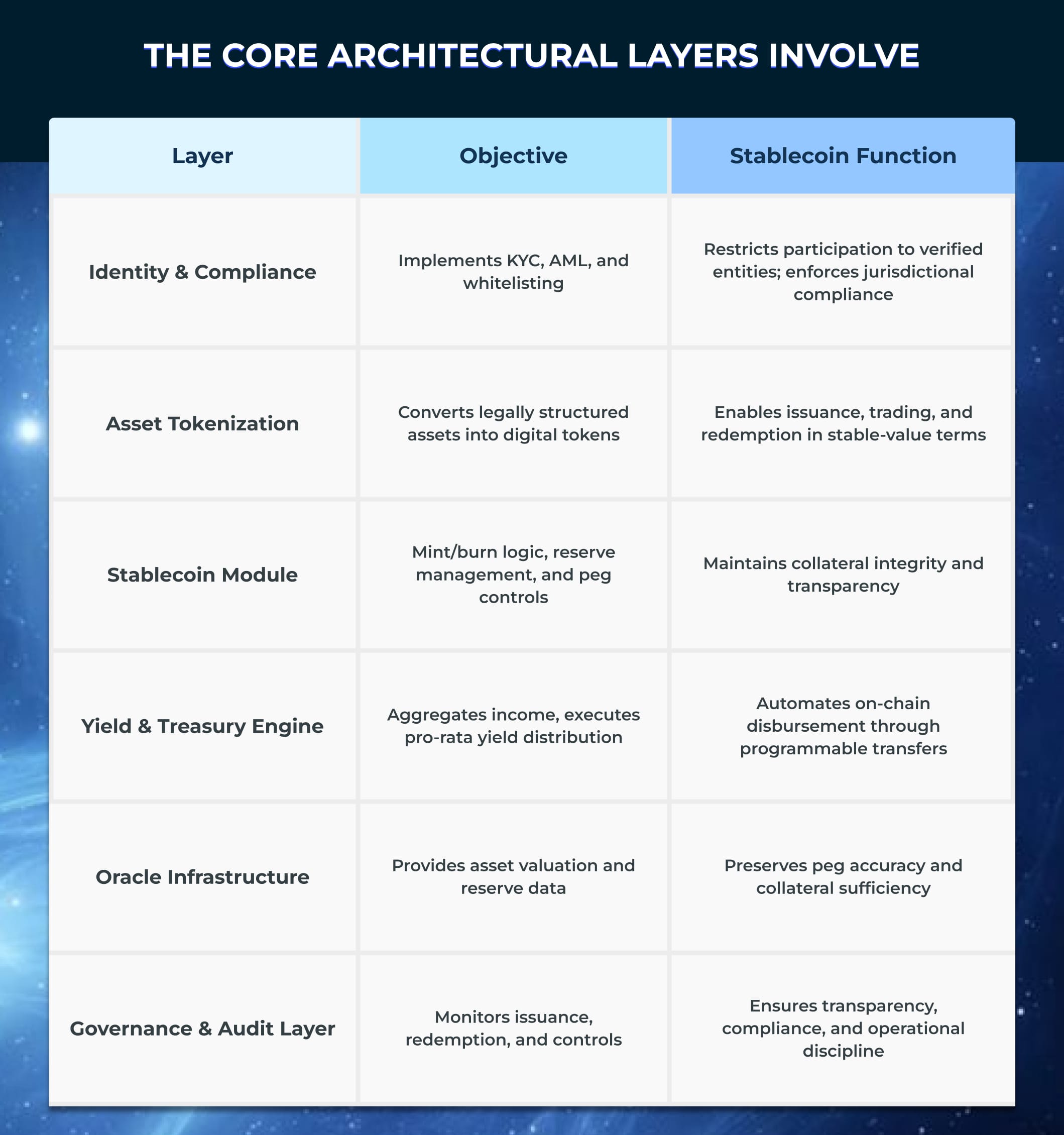
Every component must interoperate seamlessly to maintain a single source of truth, from asset origination to investor redemption, all anchored by a compliant, reserve-backed stablecoin.
How To Ensure Governance, Compliance, and Transparency Tokenization Platform?
Institutional adoption depends on governance discipline. A stablecoin supporting tokenized real-world assets must meet regulatory, operational, and audit thresholds comparable to traditional financial instruments.
Key Governance Pillars
Reserve Management
Reserves must remain segregated, fully verifiable, and independently audited. On-chain attestations should continuously disclose backing ratios and liquidity profiles.
Regulatory Conformance
The stablecoin’s legal classification should align with jurisdictional frameworks for e-money, securities, or payment tokens. Redemption rights, disclosure standards, and AML/CFT mechanisms must be embedded in platform logic.
Smart Contract Assurance
Mint and burn operations should be controlled through multi-signature authorization and monitored by formal verification. Contracts must remain upgradeable yet auditable to ensure security and flexibility.
Without this governance infrastructure, a platform cannot scale beyond experimental deployment or qualify for institutional participation.
Move Value On-Chain Smartly with Asset Tokenization Platform
How To Manage the Associated Risks?
Risk management must be embedded at the architectural level for RWA Tokenization Platform Development. Key dimensions include:
- Reserve Liquidity Risk: Maintain high-quality, short-term reserves and structured redemption queues.
- Collateral Valuation Risk: Employ independent oracles and third-party valuation feeds.
- Smart Contract Risk: Enforce continuous audits and open bug-bounty programs.
- Operational Risk: Implement internal segregation of duties and real-time compliance monitoring.
- Market Confidence Risk: Maintain public audit reports and transparent governance communication.
Takeaway
While traditional finance transmits yield through intermediaries and custodians. The Stablecoin-backed Asset Tokenization Platform moves the yield directly from asset to investor through programmable stablecoins. This transition compresses settlement layers, reduces leakage, and converts yield distribution into an on-chain service primitive.
RWA Tokenization Platform Development with Stablecoin support enables businesses to lead the next cycle of institutional digital finance, where yield, liquidity, and trust are unified on-chain.
Partner with Antier, a leading RWA Tokenization Development Company, to build platforms that merge asset-backed stablecoins, instant settlement, and programmable yield. From compliance-ready architecture to liquidity integration, Antier transforms real-world assets into on-chain economies, empowering institutions to monetize, trade, and manage tokenized portfolios with transparency and precision
Frequently Asked Questions
01. Why is a stablecoin layer essential for an Asset Tokenization Platform?
A stablecoin layer is crucial because it provides a monetary mechanism for efficient transactions, settlements, and yield generation, ensuring market integrity through valuation consistency, settlement efficiency, and liquidity continuity.
02. What benefits does integrating a stablecoin framework offer to enterprises using RWA Tokenization Development Services?
Integrating a stablecoin framework offers immediate settlement finality, programmable financial logic for automated operations, institutional-grade stability for pricing, and unified liquidity across diverse tokenized assets.
03. How does a stablecoin layer enhance the functionality of a tokenized financial system?
A stablecoin layer enhances functionality by transforming the system from a mere record-keeping tool into a dynamic economy, facilitating seamless transactions and efficient management of asset-backed yields.


