The world of complex, wallet-dependent crypto transactions is shrinking. The new era of crypto infrastructures brings programmatic, API-driven digital asset payments. Coinbase’s x402 has blazed the trail with a lightweight payment standard built directly into the HTTP layer that has existed for over three decades, but was not implemented until now. By enabling users to pay for resources via API without requiring registration, Coinbase’s digital payment protocol introduces the most effective way to accept digital payments to date.
Source: https://www.x402.org/
For cryptocurrency exchange software planning to facilitate payments, it unlocks instant, interoperable, stateless payments that work across wallets, dApps, and chains, without any middleman, plugin, or redundant SDKs. Whether you’re planning a custom or white label cryptocurrency exchange development, x402-compliance and integration are essential for a future-proof, scalable, and machine-friendly Web3 payment infrastructure.
In this blog, we’ll cover what x402 is, its characteristics and benefits, and how businesses can benefit from x402-compliant white label cryptocurrency exchange development solutions.
What is x402?
Developed by Coinbase, X402 is an open payment protocol that revives the HTTP 402 status code – “Payment Required” for the Web3 era. In simple terms, x402 brings HTTP-native programability to crypto, not just for human users but for AI agents and autonomous bots. They can now pay, trade, and subscribe to any on-chain service directly without going through multiple gateways or smart contracts. X402 lets servers and clients communicate payment requests directly using HTTP headers.
Crypto exchange software that integrates x402 can request crypto payments as easily as it would request web pages. So, if you’re planning trading platform development, you pick an x402-compliant white label crypto exchange.

Characteristics of x402:
- No Fees for customers or merchants
- A neutral standard not tied to any token or chain
- No centralized provider, open for integration or extension
- Money in wallets received in just 2 seconds, not T+2
- Minimal middleware code in the existing stack adds the ability to accept payments
- Works effortlessly with any HTTP stack
Benefits of x402 for Crypto or Non-Crypto Service Providers:
- As explained above, Coinbase’s x402 accelerates and automates stablecoin payments on a crypto exchange software or a merchant’s PoS. However, its use case is not limited to that.
- It also enables service providers to monetize on-chain APIs and digital content, allowing clients (both human and machines) to pay for access without accounts, sessions, or complex authentication.
- Crypto exchange businesses that plan to expand into merchant payments can also streamline and accelerate the execution with x402.
Why Does x402 Matter for Crypto Exchange Software Development?
| Attribute | Description | Why It Matters for Exchanges |
|---|---|---|
| Protocol Type | Open standard over HTTP | No proprietary dependencies |
| Purpose | Programmatic, crypto-native payments | Enables machine-to-machine payments |
| Assets Supported | Stablecoins (USDC) and on-chain tokens | Stable, fast settlements |
| Architecture | Stateless (no session binding) | Perfect for high-throughput APIs |
| Integration Layer | Web3 wallets (Coinbase Wallet, WalletConnect) | Enables direct, user-authenticated payments |
In essence, x402 turns any HTTP endpoint into a payment gateway, bridging traditional API systems with the world of on-chain assets.
What are the Challenges That x402-Compliant White Label Crypto Exchanges Solve?
White label cryptocurrency exchange development solutions allow businesses to launch branded trading venues, and they often lack technology that enables:
- Effortless, bridgeless stablecoin trades
- Monetization of on-chain premium features and APIs in crypto exchanges (B2B & B2C both)
Traditional payment flows, facilitated by third parties, usually involve custodial intermediaries, expensive API integrations, and limited automation for microtransactions.
The advent of X402 changes this dramatically. X402-compliant white label crypto exchange software can allow trading platforms to:
- Request fees, deposits, or access payments directly via HTTP calls
- Settle instantly in stablecoins like USDC on Base or Ethereum
- Monetize APIs and liquidity programs automatically
This makes x402, Stripe for on-chain assets – open, composable, and programmable.
How to Integrate x402 into Cryptocurrency Exchange Software?
If you’re on your way to building your crypto trading empire, picking an x402-compliant white label crypto exchange software would be the best deal. However, if you’re deploying the payment protocol into your existing white label exchange software, these are the steps you must follow:
Step 1: Add x402 Headers to Your API Endpoints
Collaborate with your white label crypto exchange developers to configure the exchange API to respond with a 402 Payment Required status whenever a payment is needed.
For example:
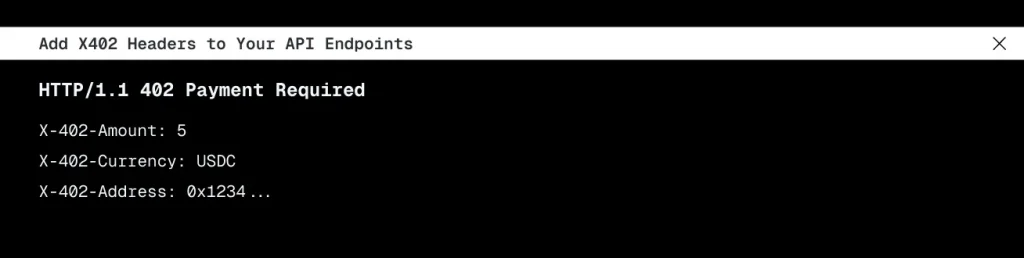
The response tells the client (human, bot, or AI agent) exactly what needs to be paid, how, and where.
Step 2: Connect Wallets For Payment Fulfillment
- Client Wallet Integration (Payment Sender): Integrate Trust, Coinbase Wallet SDK, WalletConnect, or similar APIs to enable users, bots, or AI agents to sign and send payments automatically based on the 402 response. The client’s wallet executes the on-chain payment and returns a payment payload (proof of payment).
- Exchange Wallet (Payment Receiver): The exchange backend listens for the incoming transaction to its receiving address. It may use a facilitator service or blockchain listener to verify the on-chain payment details (amount, token, sender). However, exchanges can also be configured to query the blockchain to confirm the settlement.
Once verified, the server automatically reissues the original request and delivers the requested resource.
Step 3: Manage Edge Cases and Multi-Chain Logic:
Your white label crypto exchange development company will also implement smart contracts for the following logics:
- Sometimes a transaction fails (user cancels, gas too low, wrong network). The server should be able to detect that no valid payment arrived within the allowed time and resend a 402 Payment Required message to prompt clients or AI-agents to re-attempt payment without breaking the flow.
- X402 is chain-agnostic. It only defines the communication standard, not which blockchain to use. So your cryptocurrency exchange software can specify in the 402 response which network it accepts payments on.
- If the client (human or bot) accidentally sends the same payment twice or retries the same request after a timeout, your server should recognize it as already paid and not charge again. This prevents duplicate billings, which are essential for AI agents that retry automatically.
- Every x402 transaction or activity comprising the request, payment details (sent and received), and verification result, should be logged on the blockchain. This builds a compliance trail for audits, disputes, or refunds.
How X402 Compliance Can Unlock 10X Growth for Your Crypto Exchange Software?
X402-compliant white label crypto exchanges can introduce new, frictionless revenue models that actually boost their bottom line.
| Attribute | Description | Why It Matters for Exchanges |
|---|---|---|
| API Monetization (Pay-Per-Call) | Charge developers, AI agents, or apps for each API request (market data, analytics, liquidity info). | Creates recurring micro-revenue without subscriptions. |
| Dynamic Fee Tiers | Use X402 to auto-adjust fees based on trading volume or asset volatility. | Maximizes revenue during high-demand periods; encourages retention. |
| Token Listing & Liquidity Sponsorships | Projects can pay via x402 for instant listing, liquidity seeding, or market-making automation. | Converts token launches into on-chain, auditable revenue events. |
| Instant Withdrawal Fees | Implement x402-triggered micro-fees for instant or cross-chain withdrawals. | Adds passive income from high-frequency traders seeking speed. |
| Premium AI or Data Plugins | Offer AI-powered analytics or predictive modules (e.g., sentiment, risk) accessible via x402 payments. | Adds SaaS-style recurring revenue inside your exchange. |
| Programmatic Rebates & Incentive Fees | Automated, rule-based payouts tied to trading activity or liquidity. | Increases trading volume while maintaining a positive fee balance. |
| Agent Subscription Services | Allow AI agents or trading bots to subscribe to execution nodes or data endpoints via x402. | Machine-native recurring revenue with zero billing overhead. |
| Affiliate / Referral Payments | Track referrals via x402-verified headers; trigger micro-commissions automatically. | Transparent and instant affiliate settlements. |
| Compliance-as-a-Service | Offer on-demand KYC, AML, or risk checks billed per API call via x402. | New revenue line targeting institutional clients needing modular compliance. |
| Instant Settlement Fees | Take a small cut for providing same-block or fast-finality settlements via your network. | Monetizes the speed advantage of your underlying blockchain. |
| Cross-Chain Swap Fees | Charge per swap or collateral transfer executed between supported chains. | Adds income layer as interoperability demand grows |
This kind of micro-billing capability is nearly impossible with traditional payment APIs.
How x402-Compliant White Label Exchange Software Prepares Businesses For AI-Web3 Future?
Apart from the revenue streams mentioned above, x402 positions your cryptocurrency exchange software for AI-native finance. When AI agents, bots, and web3 applications function, they consistently need to pay for:
- Buying data feeds
- On-chain gas
- Trades executed autonomously
With x402, these machine-to-machine payments can occur securely and transparently without human intervention. This opens up programmable commerce, where payments become native to software logic rather than external processes.
The HTTP Payment Revolution in Web3 Has Begun
X402 is doing for Web3 payments what HTTP did for the internet. With x402-compliant white label crypto exchanges, businesses transform from being static trading venues to programmable financial APIs, ready for compliance, AI, and global scale. Businesses that embrace it now will lead the new age of HTTP-native crypto payments that feature:
- No middleware: direct payment communication via HTTP
- Fewer integrations: no dependency on centralized payment processors
- Faster deployments: ready-to-use with Antier’s modular white label stack
- Auditable transactions: every HTTP payment request is logged for regulators
- Multi-chain support: run settlements across Base, Ethereum, or Layer-2s
HExplore the features of Antier’s x402-compliant white label exchange
How is Antier Integrating x402 Into Its White Label Exchange Stack?
Antier’s development team is actively incorporating x402 compatibility into white label cryptocurrency exchange development framework, enabling businesses to offer:
- API-first architecture with 402 status support
- Wallet abstraction and native USDC-on-Base integration
- Dynamic billing engines for API and liquidity transactions
- Audit-ready compliance logs for regulators and partners
- AI-agent-ready endpoints for autonomous trading systems
Antier’s X402-ready exchange infrastructure gives partners programmable payments.
Share your requirements right away!
Frequently Asked Questions
01. Can Antier’s white label crypto exchange support X402 payments?
Yes. Antier’s exchange architecture is API-first and HTTP-native, making it ready for X402 integration. This enables automated stablecoin payments, AI-agent billing, and instant settlements directly through exchange APIs.
02. How does X402 enhance revenue for white label exchanges?
It introduces dynamic monetization—like pay-per-trade, premium API access, and instant KYC billing. Each user or AI-agent action can trigger microtransactions, creating a continuous revenue flow without manual billing.
03. Do Antier exchanges require intermediaries for X402 transactions?
No. X402 enables direct wallet-to-wallet settlements. Payments move from the client’s or AI agent’s wallet straight to your exchange wallet—no custodians, gateways, or off-chain processors.
04. Do Antier exchanges require intermediaries for X402 transactions?
Each payment is on-chain, verifiable, and signed by the payer’s wallet. Antier’s backend automatically validates transaction proofs before releasing resources, ensuring a zero-trust, auditable payment model.
05. Can businesses customize X402-based billing in their exchanges?
Yes. Antier’s admin dashboard allows businesses to define custom fee logic—like per-API pricing, tiered commissions, or market-maker rebates—fully compatible with X402’s payment payloads.


