The prediction market race in the U.S. has just received another high-value signal from Kalshi. According to a filing with the U.S. Securities and Exchange Commission dated Aug. 25, the company has sold $1.12 billion in stock through a private offering. This capital influx comes as the market accelerates, driven by investor capital inflows, surging trading volumes, and the increasingly prominent involvement of major financial institutions.
The Filing Behind the $1.12B Figure
Kalshi has not officially announced a new $1.12 billion funding round via a traditional press release. The SEC Form D filing confirms that Kalshi Inc. sold $1,120,010,122 in stock in an offering totaling $1,499,997,894. CEO Tarek Mansour signed the filing on Aug. 25, and it lists the date of first sale as April 3.
This detail is important because Form D does not provide full details on transaction structure, valuation, investor names, or whether the amount sold belongs to an independent new round. The filing also shows that Kalshi still has approximately $379.99 million remaining unsold in this offering, with 71 investors participating.
The most recent context is the $1 billion Series F round that Kalshi announced in May, which valued the company at $22 billion. The round was led by Coatue, with participation from Sequoia Capital, Andreessen Horowitz, IVP, Paradigm, Morgan Stanley, and ARK Invest. Prior to that, Kalshi was valued at $11 billion in its Series E round in December 2025, meaning the company’s valuation doubled in just a few months.
Why Investors Are Piling Into Prediction Markets
When announcing its Series F in May, Kalshi stated that institutional trading volume had grown 800% in six months, while annualized trading volume jumped from $52 billion to $178 billion. The company also claimed its platform accounts for over 90% of U.S. prediction market activity.
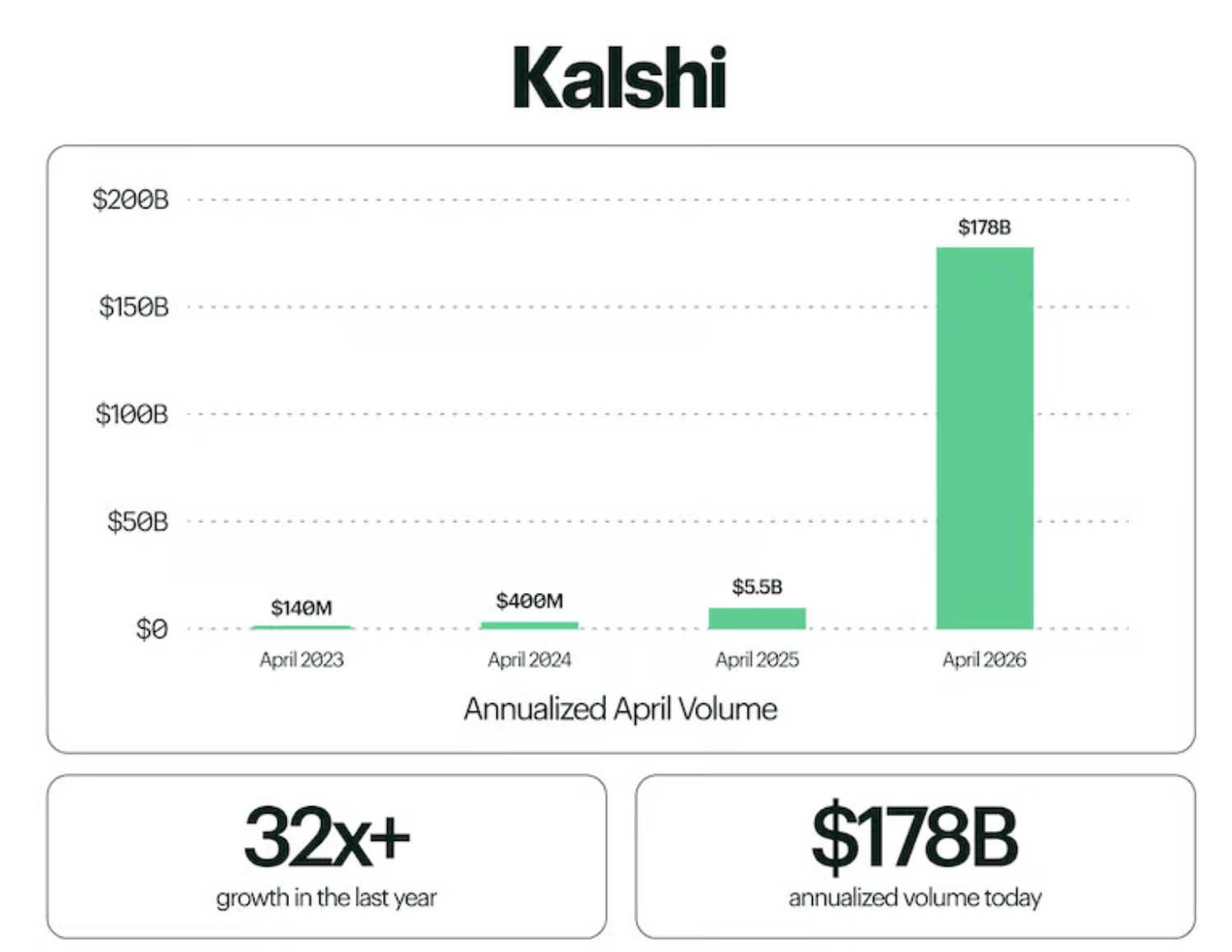
Kalshi Annualized Trading Volume. Source: Kalshi
Prediction markets allow users to trade contracts based on the outcomes of events such as elections, sports, economic indicators, weather, or crypto prices. Volume does not equate to revenue. Exchange revenues typically come from transaction fees, so figures in the tens of billions of dollars reflect liquidity and user activity rather than direct revenue.
Kalshi is also expanding into additional contract categories beyond political and sports events. Previously, the company announced a partnership with The Weather Company to develop additional weather and climate-related markets. Kalshi noted that this product category grew 500% year-over-year and is targeting $1.1 billion in annualized volume.
The Race With Polymarket Is Getting More Expensive
Kalshi enters this major capital-raising phase while Polymarket is also receiving additional backing from financial institutions. In March 2026, Intercontinental Exchange, the parent company of the New York Stock Exchange, announced an additional direct investment of $600 million into Polymarket. This followed a $1 billion investment by ICE in October 2025, bringing the total capital ICE has injected into Polymarket to roughly $1.6 billion. ICE also holds options to purchase up to an additional $40 million in securities from existing shareholders.
In early August, Bloomberg reported that Polymarket was in preliminary talks to raise around $1 billion at a valuation exceeding $20 billion, just months after an April round that reportedly valued the company at around $15 billion. To date, Polymarket has not officially announced a new funding round.
In addition, Robinhood launched an in-app prediction markets hub in March 2025, initially using Kalshi for contract order matching. The participation of Robinhood and ICE indicates that prediction markets are moving closer to mainstream financial infrastructure, rather than remaining a niche set of platforms for event-driven traders.
Regulatory Risk Remains the Biggest Overhang
KalshiEX was approved by the CFTC as a Designated Contract Market in 2020, which serves as the basis for the company’s argument that its event contracts fall under federal oversight. However, that argument is being challenged as Kalshi expands into sports and elections. On July 31, New York sued Kalshi, alleging that the company operates an unlicensed gambling business in the state. Before that, on March 17, Arizona filed 20 criminal misdemeanor counts against KalshiEX LLC and Kalshi Trading LLC, related to unlicensed gambling activities and election wagering.
The $1.12 billion filing puts Kalshi in the spotlight at a time when prediction markets are attracting massive new capital while simultaneously facing unresolved regulatory hurdles. The outcome of these lawsuits will directly impact Kalshi’s expansion pace in the U.S. as the company continues to push sports and weather contracts alongside institutional products.