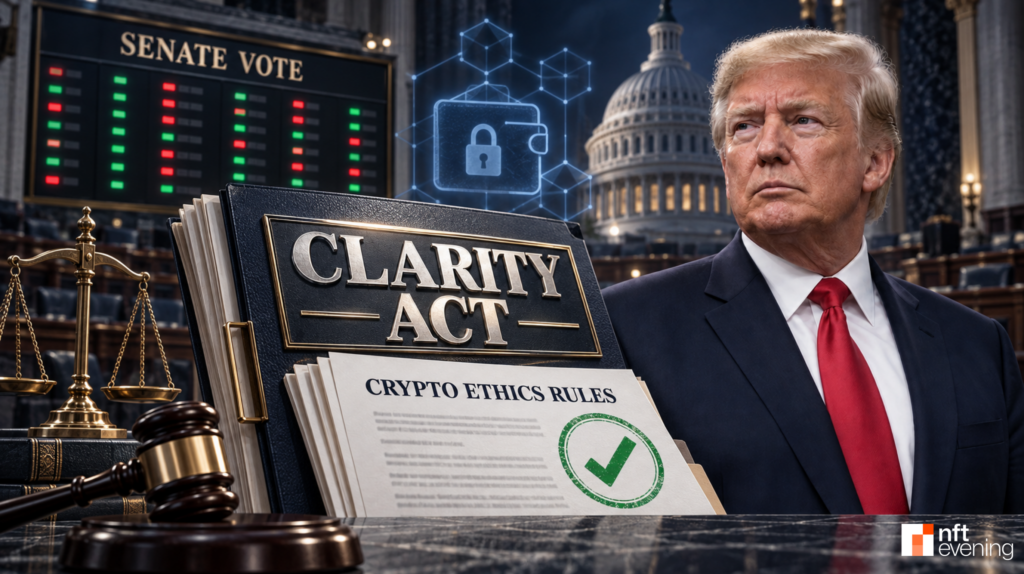
President Donald Trump has agreed to most of a bipartisan proposal to tighten ethics rules for federal officials with crypto-related interests, according to three Republican lawmakers leading the CLARITY Act. The concessions were made to attract Democratic votes ahead of a procedural vote in the Senate at around 2:15 p.m. Eastern Time on September 15.
The vote requires 60 votes to clear the way for Senate consideration of the bill. Still, the outcome remains uncertain as some Democratic lawmakers argue the draft amendment does not fully address conflict-of-interest concerns.
Trump Gives Ground on Ethics
The 635-page draft released on September 14 by Senators Cynthia Lummis, John Boozman, and Tim Scott includes 126 changes that sponsors said were made at the request of Democrats. The three lawmakers said the new ethics section reflects “nearly the entire” Tillis–Gallego proposal, while a senior Republican aide said Trump accepted about 80% of the provisions.
Under the text, the rules apply to public officials and employees, individuals who have been elected president, vice president, or to Congress but have not yet taken the oath of office, as well as their spouses. Sponsors said federal judges also fall within the scope.
These individuals are prohibited from issuing or sponsoring a digital asset in exchange for financial gain. The concept of “sponsor” includes licensing, revenue-sharing, or transaction fee agreements aimed at promoting a token, as well as allowing the use of their name, image, or office during the issuance.
They are also prohibited from maintaining a “significant financial interest” worth $15,000 or more in an entity that derived its largest source of revenue from issuing or sponsoring digital assets in at least one of the preceding three years. Such interests must be divested or transferred into a qualified blind trust. The final version also removes a clause that previously allowed the ethics restrictions to expire in January 2029.
These changes could directly affect Trump’s business interests. In his 2025 financial disclosures, he reported at least $1.4 billion in crypto-related income, including about $594 million from World Liberty Financial, $636 million from meme-coin-related activities, and nearly $197 million from a stake sale involving Stablecoin Holdco. Most of these funds came from one-off token transactions and equity sales, which does not necessarily reflect net profit.
Enforcement Divides the Negotiators
The draft meets a key Democratic demand by giving state attorneys general an enforcement role. However, they are not permitted to directly sue accused officials in all circumstances.
For official violations, state attorneys general can sue the U.S. Attorney General to seek injunctive relief. They have the right to directly sue a crypto exchange or intermediary if the platform lists a digital asset issued in violation of the ban.
This mechanism still reserves significant authority for ethics oversight entities, which can determine that an activity is not prohibited or confirm that a covered interest has been handled according to regulations. The measures also do not apply to adult children of officials and only take effect after the law is enacted and through the regulatory implementation process.
For officials, the bill establishes a minimum fine of $500,000, or 20% of the income or value of the covered interest, whichever is higher. Unlawfully issuing or sponsoring tokens also requires disgorgement of all profits. Intermediaries violating the listing ban could face fines of up to $250,000 per violation per day.
Gallego said the new ethics section still “falls short in many areas” and that Democrats will offer a counterproposal.
SEC-CFTC Split Anchors the Bill
Beyond the ethics provisions, the CLARITY Act would establish a new oversight framework for the approximately $2.3 trillion global crypto market, focusing on jurisdictional boundaries between the two major U.S. financial regulators.
The CFTC will oversee most spot transactions for digital commodities, while the SEC continues to regulate securities and disclosure requirements related to certain network tokens. Exchanges, brokers, dealers, and custodians falling within the bill’s scope will be required to register, protect customer assets, and comply with anti-fraud, market manipulation, and illegal finance regulations.
The final version also specifies when a DeFi protocol determined to be non-decentralized must register and fulfill obligations under the Bank Secrecy Act. Certain developers who do not control customer assets, along with miners and validators, will not be automatically classified as money transmitters or financial institutions. However, the draft removed explicit criminal liability protections regarding 18 U.S.C. §1960.
The bill also grants the Treasury Secretary the power to limit stablecoin rewards if it is determined that deposit flows are leaving community banks on a significant scale. This “circuit breaker” mechanism will exist for only 18 months after the law’s enactment.
A Narrow Path Through Congress
The House of Representatives passed H.R. 3633 by a 294-134 vote in July 2025. In May 2026, the Senate Banking Committee approved the portion of the bill under its jurisdiction by a bipartisan 15-9 vote. The text currently before the Senate is a substitute version that differs significantly from the version passed by the House.
If cloture is invoked, the Senate must still complete procedural steps to bring the bill up for consideration, address the substitute text along with amendments, and hold a final passage vote. Because the two versions are not identical, the House must subsequently accept the Senate text or both chambers must agree on a reconciled version before transmitting it to the president.
This week is expected to be the only time the House and Senate work concurrently in Washington prior to the mid-term elections on November 3. Any delays could push consideration into the post-election lame-duck session. If it fails to clear cloture on September 15, the CLARITY Act remains on the Senate calendar, but its chances of becoming law this year will narrow significantly.