New report highlights rapid growth in sports event contract trading, growing regulatory stakes and how prediction markets could reshape the broader online gambling landscape
A new industry report released this week by gambling industry media and events firm NEXT.io suggests prediction markets could grow into a trillion-dollar trading market, as activity around sports and other event contracts accelerates.
The report estimates global prediction market transaction volume reached $63.5 billion in 2025, up roughly 400% from the previous year, citing industry analyses from firms including Eilers & Krejcik Gaming and Citizens Financial Group. It projects weekly trading could eventually reach $25 billion, implying a potential $1.3 trillion annual market if growth continues. Separate analysis from Citizens suggests the sector could eventually generate more than $10 billion in annual revenue by 2030, as trading volumes grow and institutional participation expands.
The 57-page report, titled Prediction Markets and Online Sports Betting: The Winners, the Losers, and How to Navigate a New Frontier, was released to coincide with NEXT Summit: New York 2026, a gambling and sports betting industry conference in Manhattan that is expected to draw more than 1,200 executives, investors and operators for discussions on emerging sectors.
Current market activity provides additional context for the report’s projections. Data from DeFi Rate’s live prediction market dashboard, which tracks activity across top platforms including Kalshi and Polymarket, shows weekly trading volumes regularly topping $5 billion, with peak periods approaching $6 billion.
Sports contracts driving prediction market activity
Sports markets account for the vast majority of activity in prediction markets, highlighting why the category has drawn increasing attention from both sportsbooks and regulators. Long-term growth may depend in part on whether prediction markets expand beyond sports into other event categories and attract greater participation from institutional traders.
Trading category mix
“More than 90% of current volume in the market is in sports, and it’s primarily retail-driven,” said DJ Hennes, advisory managing director at the U.S. arm of global accounting and consulting firm KPMG, in commentary included in the report. “The big questions our clients are asking are: What will that mix look like in five years? Will politics, climate, financials, or corporate events take up more share? And will institutions start participating in a more meaningful way? I think the answer to both is yes.”
For the week of March 2-8, a notably slower week for sports, Kalshi‘s sports category accounts for 69.7% of its volume, according to Dune. That number likely undersells the full makeup of sports, as the second-highest category “Exotics” (13.4%) includes combos (parlays) which are primarily sports-related for now. Meanwhile, crypto made up 9% and politics just 2.0% in the same week. Lately, Kalshi’s sports volume has been trending around 80% of its weekly total, our most recent volume reports show.
Polymarket‘s sports trading volume is also surging, crossing $1B for the first time last week and accounting for 40.8% of its total weekly platform volume. Polymarket runs notably more diversified — its top 3 categories are all above 20%, whereas Kalshi outside of sports drops off sharply. Last week, crypto made up 29.0%, politics 20.4% and Polymarket’s “Trump” category represented 6.3% of total volume.
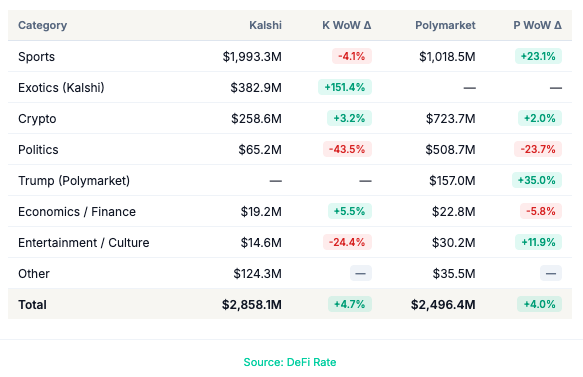
Sports contract growth impossible to ignore
Analysts cited in the NEXT.io report estimate that between 5% and 10% of U.S. sports betting activity could eventually migrate to prediction markets, a shift that could reshape competition between traditional sportsbooks and event contract exchanges. However, the report also warns the category’s rapid growth could face significant downside risk if regulators ultimately restrict sports contracts. In such a scenario, trading volume across prediction markets could decline by as much as 80%, according to the analysis.
The dominance of sports event contracts reflects the way prediction markets have evolved over the past year. Platforms now list markets on game outcomes, player performance and other sports-related events, attracting a retail audience that often overlaps with traditional sports bettors.
Industry observers cited in the report say the dominance of sports markets has begun drawing interest from established gambling operators and investors who see prediction markets as a potentially new trading category rather than simply another format for sports wagering.
“Prediction markets have reached an inflection point,” said Meredith McPherron, CEO and managing partner of DraftKings’ venture capital arm, Drive by DraftKings. “Seeing $1.3B+ traded on Super Bowl Sunday alone made it clear this is no longer niche, it’s becoming a real, investable category.”
A race to build the prediction market ecosystem
The report also describes the prediction market industry as entering a competitive buildout phase, with exchanges, sportsbooks and fintech firms racing to establish platforms and capture trading activity.
Analysts cited in the report characterize the current environment as a “land grab,” with new entrants seeking to build infrastructure, attract liquidity and secure regulatory positioning before the market matures.
“Our baseline view is that there is something very real here. There’s a genuine use case, real demand, and an emerging market structure around event contracts,” said Shaun Kelley, gaming, lodging and leisure equity research analyst at Bank of America.
“At the moment, this market shows all the signs of an early-stage land grab,” Kelley continued. “That’s typically followed by a shakeout. You have high valuations, unclear unit economics, and intense price competition. Everyone rushes in, raises capital, and chases growth. Then reality sets in and only a handful of players emerge as long-term winners.”
Kalshi and Polymarket are currently the dominant players, according to the report, which says both companies helped bring prediction markets into the mainstream by attracting retail traders and building liquidity around major events.
At the same time, the report suggests that distribution platforms could play an increasingly important role in shaping the market’s development. Brokerage firms with large retail trading bases, like Robinhood, may ultimately determine where trading activity flows by routing user orders to specific exchanges. The report notes that Robinhood funnels a significant share of U.S. prediction market volume to Kalshi, illustrating how broker platforms can influence liquidity across the ecosystem.
Prediction markets face a regulatory crossroads
Consumer interest in prediction markets has also grown rapidly alongside trading activity, according to data cited in the report. Search demand for the category rose from roughly 1.7 million queries in early 2025 to more than 8.6 million by early 2026, reflecting rising public awareness of event contract trading platforms.
The NEXT.io report concludes that if prediction markets continue to gain traction, they could reshape the broader U.S. gambling landscape in unexpected ways. If prediction platforms capture a meaningful share of sports wagering activity, some states may feel less urgency to legalize traditional sportsbooks.
Instead, lawmakers in states that rely on gambling taxes could increasingly look toward online casino gaming as a more predictable source of revenue, the report states. Online casino products generate steadier returns than sports betting, potentially allowing states to offset revenue losses without directly competing with federally-regulated event markets.
There is also the possibility of federal intervention, the report notes, as policymakers consider whether existing gambling and commodities laws should be updated to clarify the legal status of prediction markets, a question analysts say could ultimately determine how the industry develops.
“The real question, whether this is a bubble or something structurally durable, comes down almost entirely to regulation,” said Bank of America’s Kelley. “The regulatory backdrop is still fluid.”

Mike Breen
Mike Breen has been a professional writer and editor covering a wide range of topics for more than 30 years. He’s been a freelance gaming industry writer since 2020, reporting on sports betting, online casinos, and more for various Catena Media sites, and he began reporting on prediction market industry news in 2025 for Prediction News. Prior to that, Mike was a founding editor at his hometown altweekly newspaper in Cincinnati, Ohio, where he extensively covered local arts, music and news.Mike’s published writing has received recognition and several awards from organizations like the Society of Professional Journalists and the Association of Alternative Newsmedia.When Mike is not working, he enjoys playing and listening to music, attending comedy shows, watching movies, and spending time with his family and three cats.