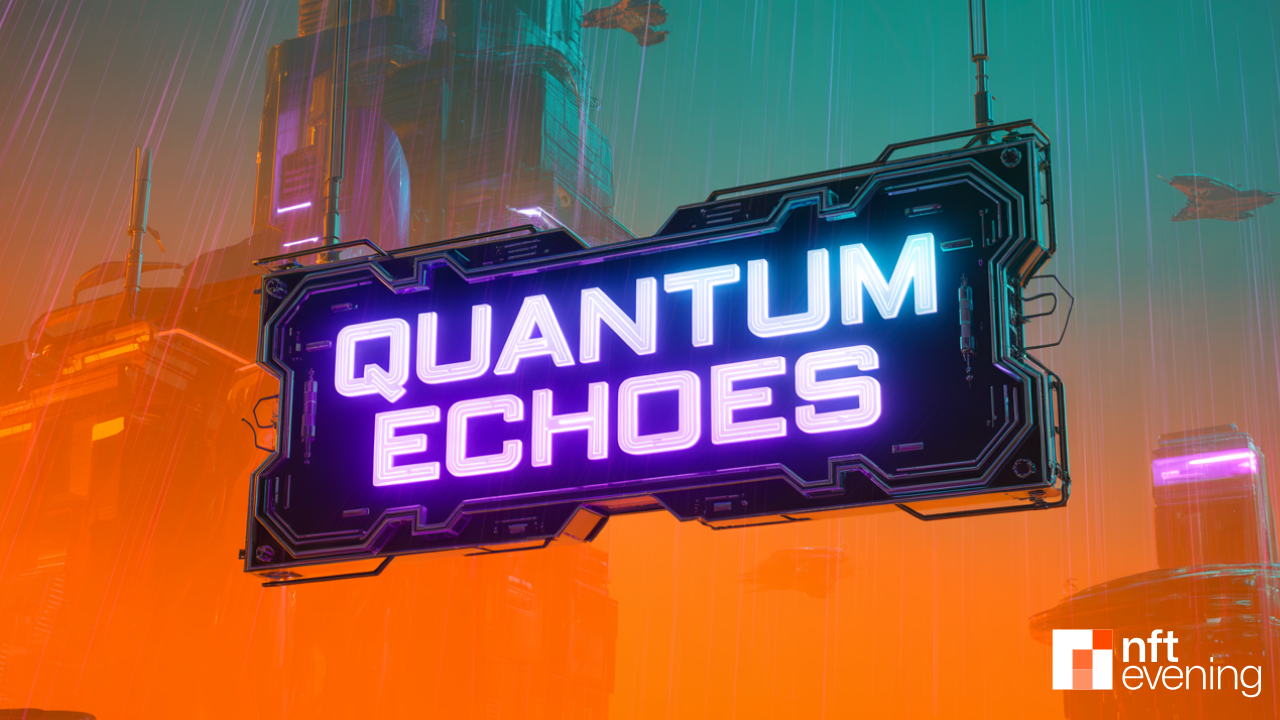
CASPER, Wyo., USA – 10 September, 2026 – Postquant Labs, the developer behind quantum computing marketplace quip.network, announces the upcoming launch of Quantum Echoes, the first digital collectibles seeded and generated by actual quantum hardware. Available from September 14, 2026, the collection marks a historic moment where ordinary consumers can own art generated directly by quantum processors, bridging the gap between inaccessible supercomputing tech and consumer culture.
Launching as a free open-edition mint on Ethereum via OpenSea, Quantum Echoes utilizes gate-based quantum computers to introduce verifiable quantum randomness into generative art.

Unlike traditional algorithmic generation, each piece in the collection is generated uniquely from physically unclonable quantum information, effectively allowing every collector to ‘roll the RNG’ with quantum mechanics.
Colton Dillion, CEO and co-founder of Postquant Labs, said:
“We’ve spent the last hundred years telling people that quantum is this spooky and mysterious thing that even the smartest people in the world don’t understand. With Quantum Echoes, we are making multimillion-dollar quantum hardware tangible for everyone, proving that quantum computing can be part of our daily digital lives and not only limited to supercomputing labs or classified facilities. And this isn’t only an art drop. Every mint is a real quantum computer doing useful, paid work — the first time our network has turned quantum hardware into an economic engine, not just a research curiosity.
The collection redefines the concept of scarcity and security in the digital age. By leveraging Quip Network’s worldwide quantum computer, where hardware providers pool idle capacity and developers rent out reusable programs, Quantum Echoes serves as the first practical demonstration of this ecosystem for the general public.
Quantum Echoes also marks the kickoff of Quip Network’s second subnet, a random circuit sampling subnet purpose-built to generate verifiable quantum randomness at scale. This matters beyond the art itself: gate-based quantum computers, the kind made by providers like IBM and IonQ, have historically struggled to compete with state-of-the-art computer clusters on combinatorial optimization problems, the workload Quip’s earliest deployments were built around. The random circuit sampling subnet gives these machines a genuinely useful, monetizable role on the network for the first time, letting them earn token revenue by supplying randomness rather than sitting idle. This is the first of many future subnets targeted at gate-based quantum computers, where each new proof of useful work benchmarks the participating architectures, discovers their unique strengths, and helps them to monetize their unused capacity.
Dr. Richard Carback, CTO and co-founder of Postquant Labs, added:
“Random circuit sampling is a benchmarking tool that proves a device is truly quantum, as classical computers cannot replicate it efficiently. It is the same class of workload behind the landmark ‘quantum supremacy’ demonstrations, a quantum processor doing what today’s most powerful classical supercomputers effectively cannot. We are repurposing this diagnostic to unlock a cryptographically secure random number generation service that powers Quantum Echoes. Every output is derived from a real quantum measurement, and its origin is fully verifiable. This proves that the hardware used can perform useful, paid work on the network, making randomness our second key workload.”
Key Features of Launch:
● Quantum Verifiable Randomness: Every trait is determined by actual quantum state collapse, not pseudorandom algorithms.
● Open-Source Accessibility: A free mint queue ensures no financial barriers to entry for the common edition.
● Eigen Keys: Community partners and loyal members earned Eigen Keys, which guarantee a rare edition at reveal. This rare supply of 1,000 items offers enhanced traits verified by the same quantum infrastructure. Non-key holders can still pull rares at reveal, just without the guarantee.
Quantum Echoes will be launched and accessible onchain on Ethereum through the world’s largest digital collectible marketplace, OpenSea. Holders will reveal their QFTs at echoes.quip.network, roughly one week after mint.
Beyond digital art, the same random circuit sampling subnet powering Quantum Echoes is designed to serve broader applications, including casino and igaming platforms that require provably fair randomness. Quantum Echoes is the network’s first public demonstration of this capability. It establishes verifiable quantum randomness as a standalone service that third parties can tap into, positioning QFTs as infrastructure rather than a one-off collectible drop.