Users can swap TRX to USDT TRC20 without creating an account through non-custodial instant exchangers and on-chain DEXs. The main extra cost on TRON is network resources: Energy and Bandwidth. Without Energy, a USDT transfer typically burns about 6.5 TRX, or roughly double for a new address. Understanding these costs is essential before calculating the true all-in price of any swap. Here’s how the accountless options work, what TRON’s network fees actually cost, and how to complete the swap safely.
Why Is TRX to USDT TRC20 a High-Demand Pair?
TRX is the native coin of the TRON network. USDT TRC20 is Tether issued on TRON and remains one of the most widely used dollar stablecoins for transfers because of relatively low network costs and high throughput.

Many users move between the two for practical reasons:
- Converting trading profits or holdings into a stable dollar asset
- Preparing USDT for transfers or payments on TRON
- Rebalancing between the network’s native coin and its dominant stablecoin
- Moving value without relying on a full centralized exchange account
Because both assets live on the same chain, the swap itself can be relatively straightforward. The complexity appears mainly in network resource costs and in choosing a service that does not require registration.
What Does “Without an Account” Actually Mean?
“Without an account” typically refers to services that allow a wallet-to-wallet swap without creating a permanent user profile or completing mandatory identity verification for standard orders.
This usually includes:
- Non-custodial instant swap aggregators/exchangers
- On-chain DEXs on TRON
It does not mean the complete absence of compliance controls. Many instant swap services still apply risk-based AML screening. Flagged deposits can be delayed or reviewed even when no account was created.
It also does not remove network fees. On TRON, sending TRC20 tokens still consumes Energy and Bandwidth. The sender normally bears those network resource costs.
What Are the Main Ways to Swap TRX to USDT TRC20 Without Registration?
1. Non-custodial Instant Swap Services
These platforms source liquidity and let users send TRX from a self-custody wallet and receive USDT TRC20 at a specified address. No permanent account is required for standard swaps. Quotes are shown before the user sends funds.
One example of this model is a TRX to USDT exchange available through Quickex. Quickex states a 0.5% fee for floating-rate swaps and a 1% fee for fixed-rate swaps, plus the applicable network commission.
2. On-chain DEXs on TRON
Users connect a TRON wallet and swap directly against liquidity pools. Settlement is on-chain. This path also requires no exchange account, but the user must have enough Energy or TRX to burn.
3. Centralized Exchanges with Soft Limits
Some CEXs still allow limited activity with minimal verification, but full access usually requires KYC. This route is less relevant for users specifically seeking an accountless flow.
For users prioritising no registration, the first two categories are the main practical options.
| Route | Account required? | Main costs | What to watch |
| Non-custodial instant swap | No permanent account for standard swaps | Service fee (e.g., Quickex: 0.5% floating, 1% fixed) + network commission | Risk-based AML screening on deposits |
| On-chain TRON DEX | No exchange account | Pool fee + slippage | Need enough Energy or TRX to burn |
| CEX with soft limits | Minimal verification for limited activity; full access usually requires KYC | Exchange fees | Less relevant for an accountless flow |
How Do TRON Network Fees Work: Energy and Bandwidth?
TRON does not use a simple gas model like Ethereum. It splits transaction costs into two resources:
Bandwidth
- Pays for the size of the transaction in bytes
- Every account receives a free daily allowance of approximately 600 points
- A typical observed USDT TRC20 transfer uses roughly 345 bandwidth
- In most cases the free daily allowance covers bandwidth, so it is rarely the dominant cost
Energy
- Pays for smart-contract computation
- Required for all TRC20 transfers, including USDT
- There is no meaningful free daily Energy allowance for ordinary users
- A standard USDT transfer to an address that already holds USDT consumes approximately 64,000–65,000 Energy
- A transfer to an address that has never held USDT can require roughly double that amount, around 130,000 Energy, because a new storage record is created
These orders of magnitude are consistent with TRON developer documentation and observed mainnet transfers.
If the account has insufficient Energy, the network burns TRX from the sender’s balance to cover the shortfall. Under commonly cited chain parameters, 100 sun per Energy unit, that corresponds to roughly 6.5 TRX for a standard transfer and about 13 TRX for a transfer to a new USDT balance.
| Resource | Pays for | Free daily allowance | Typical USDT TRC20 transfer | Cost if not covered |
| Bandwidth | Transaction size in bytes | ~600 points | ~345 bandwidth | Rarely the dominant cost |
| Energy | Smart-contract computation | No meaningful allowance | ~64,000–65,000 (existing USDT holder); ~130,000 (new USDT balance) | ~6.5 TRX burned; ~13 TRX to a new balance |
Why Do You Need TRX for Fees?
Even if your goal is only to hold or move USDT TRC20, you still need TRX in the sending wallet unless you have obtained Energy another way, staking or rental.
Without Energy:
- A typical USDT transfer to an existing USDT holder burns about 6.5 TRX
- A transfer to a new/empty USDT balance can burn about 13 TRX
Practical implication: a wallet that holds only USDT and zero TRX may be unable to send that USDT until it receives a small amount of TRX, or rented Energy.
How Do You Calculate the Real Cost of a Transfer?
When estimating the all-in cost of moving value on TRON, separate the layers:
1. Swap/Trading Cost
Cost structures vary by service and may include a platform fee, liquidity-provider costs and network commissions. The most useful comparison metric is the final receive amount shown for the same input amount at the same time. On a DEX it is the pool fee plus any slippage.
2. Network Resource Cost
- Bandwidth: often covered by the free daily allowance
- Energy: ~6.5 TRX burned, existing recipient, or ~13 TRX, new recipient, if no Energy is available
3. Optional Energy Rental
Renting Energy can reduce the effective TRX spent compared with pure burning, but adds a separate payment to a rental service.
Illustrative Example — Order of Magnitude
Assume a user swaps TRX → USDT TRC20 on an accountless service and later wants to move the USDT:
- Swap spread: depends on the live quote; compare net USDT received
- Later USDT transfer from the user’s wallet:
- With no Energy: ~6.5 TRX burned to an active USDT address
- Or ~13 TRX to a first-time USDT recipient
The important point is that the quoted swap rate is not the full story. Any subsequent TRC20 movement still carries a TRON resource cost denominated in TRX. USD equivalents move with the TRX market price and should be checked at the time of the transfer.
How Do Instant Swap Services Handle the Route?
On a non-custodial instant swap service, the typical flow is:
- User selects TRX as the sending asset and USDT TRC20 as the receiving asset.
- The service shows a live quote, fixed or floating.
- User provides a TRON address that can receive USDT TRC20.
- User sends TRX to the generated deposit address.
- After confirmations and processing, USDT TRC20 is delivered to the user’s address.
The service handles the conversion. The user is still responsible for:
- Keeping a small TRX balance if they later want to send the received USDT themselves
- Selecting the correct network, TRC20 / TRON
- Verifying the receiving address
How to Complete an Accountless TRX → USDT TRC20 Swap
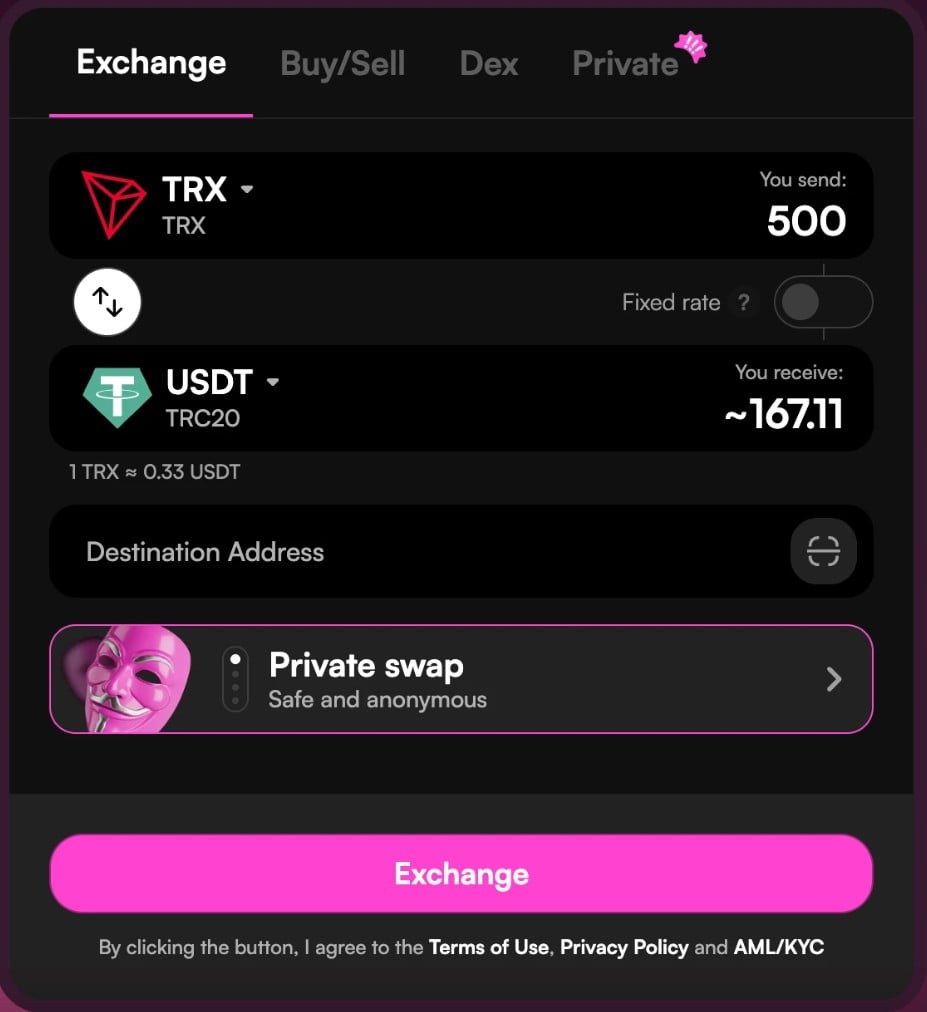
- Open a non-custodial swap interface that supports the pair.
- Select TRX → USDT TRC20.
- Enter the amount and review the quoted receive amount.
- Choose a fixed rate, locked for a limited window, or a floating rate.
- Paste your TRON wallet address for USDT TRC20.
- Confirm the order and send the exact amount of TRX to the deposit address shown.
- Wait for network confirmations and service processing.
- Receive USDT TRC20 in your wallet.
- Optionally leave or acquire a small TRX balance so you can move the USDT later without being stuck.
Should You Choose a Fixed or Floating Rate?
Fixed Rate
The receive amount is locked for a defined period. This protects against adverse market movement while the deposit confirms. A fixed rate may include a pricing premium for that rate-lock protection.
Floating Rate
The rate can move with the market between quote and execution. It may deliver a better amount in calm conditions but exposes the user to slippage.
| Rate type | How it works | Upside | Trade-off |
| Fixed | Receive amount locked for a defined period | Protects against adverse market movement while the deposit confirms | May include a pricing premium for the rate lock |
| Floating | Rate moves with the market between quote and execution | May deliver a better amount in calm conditions | Exposes the user to slippage |
For a same-chain pair such as TRX/USDT TRC20, spreads are often tighter than on cross-chain routes, but live comparison remains the only reliable way to judge cost.
What Affects the Final Amount You Receive?
- Live market rate at the moment of the quote
- Fixed vs floating selection
- Liquidity available to the service or pool
- Network confirmation speed
- Any risk-based delay on the deposit
- Later TRON Energy costs if you move the USDT onward
Users who compare only the headline rate and ignore Energy requirements often underestimate the true cost of using USDT TRC20 operationally.
What Risks and Checks Should You Consider?
- Wrong network — sending assets on the incorrect chain can result in permanent loss.
- Insufficient TRX for later transfers — a USDT-only wallet may be unable to broadcast TRC20 transactions.
- Address errors — irreversible on TRON.
- Risk-based screening — even accountless services may pause flagged deposits.
- Rate movement — especially on floating quotes.
- Energy price/policy changes — network parameters can be updated by governance.
Before swapping:
- Confirm the pair is TRX → USDT TRC20, not ERC20 or another chain.
- Verify the receiving address.
- Check whether you will need TRX for subsequent USDT transfers.
- Start with a small test amount if using a service or wallet for the first time.
- Compare the net USDT you will receive, not only the displayed rate.
Conclusion
Swapping TRX to USDT TRC20 without an account is straightforward through non-custodial instant exchangers and on-chain DEXs. The less obvious part of the cost is TRON’s resource model. Energy and Bandwidth determine what it actually costs to move USDT after the swap, and a wallet without TRX can become temporarily stuck.
Users who understand the roughly 6.5 TRX, or ~13 TRX, burn for Energy, keep a small TRX buffer, and compare net receive amounts across services are in a much better position to control the all-in cost of the route.
For an accountless conversion between the two assets, review live quotes, confirm the TRC20 network, and treat Energy requirements as part of the total cost rather than an afterthought.
Disclaimer
Energy and Bandwidth figures are consistent with TRON developer documentation and observed mainnet parameters as of September 2026: free daily Bandwidth allowance ~600; typical USDT transfer ~64k–65k Energy to an existing balance and ~130k to a new balance; Energy unit price commonly 100 sun. Always verify current resource costs and live swap quotes before transacting.
FAQs
Yes, TRX can be swapped to USDT TRC20 without creating a permanent account on certain instant-swap services or TRON DEXs. Risk-based screening can still apply on some platforms.
TRON requires Energy, or burned TRX, to execute TRC20 smart-contract transfers. A wallet with USDT but no TRX or Energy may be unable to send that USDT.
Without Energy, a typical transfer to an address that already holds USDT burns about 6.5 TRX; a transfer to a new USDT balance can cost around 13 TRX. Bandwidth is usually covered by the free daily allowance. Exact figures can vary slightly with network conditions.
Bandwidth pays for transaction size; Energy pays for smart-contract computation. USDT transfers need both, but Energy is normally the expensive part.
It depends on the live quote, pool fees, slippage, and Energy costs. The only reliable comparison is the net USDT received for the same TRX input at the same moment, plus any later transfer costs.
Several non-custodial swap services support the pair. One available route is a TRX to USDT exchange via Quickex. Always check the live interface for current availability, minimums, and rates.