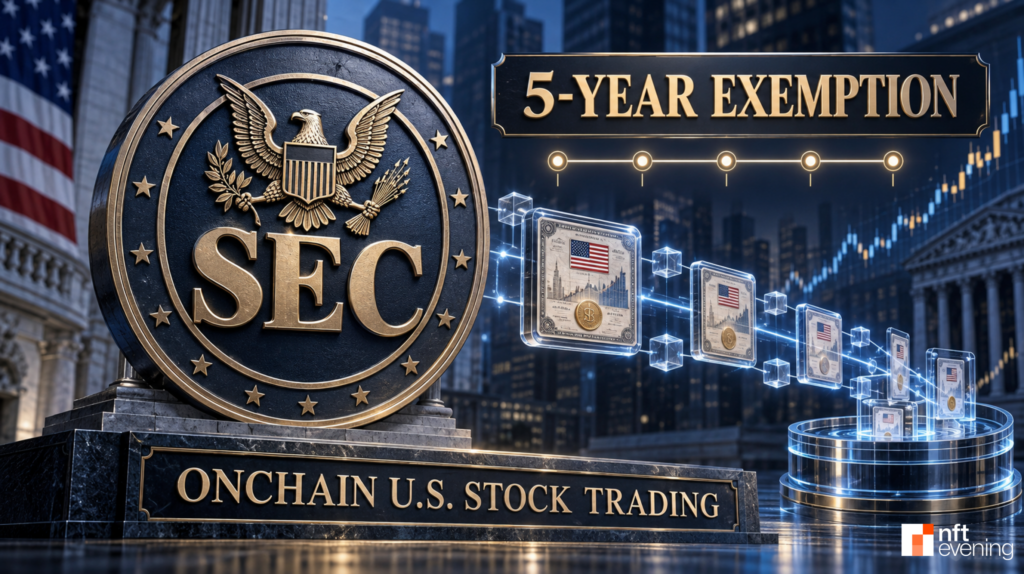
On September 17, the U.S. Securities and Exchange Commission (SEC) issued two temporary, conditional exemptions effective through September 17, 2031, paving the way for the U.S. listed stocks to be traded on-chain via automated market makers and liquidity pools designed for verified participants.
Collectively referred to as the “Innovation Exemption” the decision applies to Tokenized Securities Venues (TSV) and certain proprietary liquidity providers. The SEC limits eligible asset classes and trading volumes and requires venues to safeguard tokenholder rights and publicly disclose market data.
The SEC’s five-year regulatory carve-out
Under the SEC order, the Innovation Exemption waives two registration requirements under the Securities Exchange Act of 1934. A fully compliant TSV will not be deemed an “exchange” for activities under the program, and thus is not required to register as a national securities exchange or operate as an alternative trading system.
The second exemption applies to certain proprietary liquidity providers using their own capital to deposit tokenized stocks into AMM pools. They can quote prices or commit capital without being classified as a “dealer” under the Act, provided they trade solely for their own accounts and do not hold customer assets. Anti-fraud and market manipulation provisions remain in full force.
Tokenized stocks must preserve shareholder rights
To be traded under the new mechanism, assets must first meet the SEC’s definition of a “tokenized NMS stock.” Under this definition, the issuing company, an entity acting on its behalf, or an unaffiliated third party can tokenize an NMS stock. The scope includes listed stocks and eligible exchange-traded products, but excludes options, calls, or warrants.
Tokenized stocks must provide rights and benefits equivalent to traditional stocks of the same class. Holders must be entitled to receive dividends, voting rights, economic ownership interests in the business, and a proportionate share of assets upon liquidation. If tokens are issued by a third party, that entity must provide proxy voting materials and related corporate disclosures without charging fees to the issuer or shareholders.
Crypto assets that merely offer synthetic exposure to the price of another security are ineligible, including tokenized linked securities and security-based swaps. TSVs are also prohibited from conducting primary issuances or initial offerings. The offer and sale of tokenized stocks must still be registered under the Securities Act of 1933 or qualify for a separate registration exemption.
Trading comes with strict limits
The SEC is keeping the scale of the experiment limited from the start. For Tier 1, which includes stocks in the S&P 500, Russell 1000, and certain high-liquidity exchange-traded products, each TSV is capped at trading a maximum of 75 tickers. The trading volume for each ticker cannot exceed 0.25% of its average daily volume from the previous month. Tier 2 carries a cap of 250 tickers and a 2.5% threshold. Affiliated venues must aggregate their activity when calculating these limits. If a threshold is exceeded again following an initial violation, the affected ticker will be suspended from trading for three months.
The order also does not allow a new venue to open immediately upon the exemption taking effect. Entities wishing to operate a TSV must publish their plan at least 30 days prior to launch and notify the SEC on the next business day. For tokens created by an unaffiliated third party, the underlying issuer has an additional 30 days to object. Therefore, the exact start date for trading depends on when the venue initiates this process, not on September 17.
Activity on TSVs will be monitored through public trading data in USD, updated no later than 10 minutes after each transaction and retained for at least 30 days in a machine-readable format. Smart contracts must be public, auditable, and run on a public blockchain. When an underlying stock is halted on its primary listing exchange, the corresponding token must also be halted accordingly.
A separate track from traditional exchanges
The SEC previously approved a tokenization model for Nasdaq in March 2026. Under that model, tokenized stocks trade alongside traditional shares on a single order book, share the same execution priority, and settle on a T+1 cycle through a pilot program with the Depository Trust Company.
The Innovation Exemption enables a different deployment pathway, where trading and pricing take place within AMM liquidity pools on a public blockchain. Access to the pools is permissioned, but venues can enable trading outside traditional market hours. Trading pairs can utilize another tokenized stock, a tokenized money-market fund, or a non-security crypto asset.
The test now moves to the market
The SEC’s decision comes as stock tokenization activity continues to expand. Data from RWA.xyz on September 21 showed total distributed value reaching $3.01 billion, up 14.09% over 30 days, while the number of holders grew 82.1% to 3.72 million. The dataset includes stocks, ETFs, and synthetic products across multiple markets, making its scope broader than the group of assets eligible under the Innovation Exemption.
SEC Chairman Paul Atkins called the decision a “significant step forward” in bringing U.S. capital markets into the digital era. He noted that the exemption is temporary, allowing TSVs to test trading in a permissioned environment while the SEC continues to evaluate long-term steps for the on-chain market.
Today, we are taking a significant step forward, within our statutory authority, to bring America’s capital markets into the digital age by facilitating onchain trading of certain tokenized stocks through the “Innovation Exemption.” 🇺🇸 https://t.co/BQK0cS70lH
— Paul Atkins (@SECPaulSAtkins) September 17, 2026
During the implementation phase, venues seeking to utilize the exemption must publish their operating plans, select securities within the prescribed limits, and complete the issuer notification process. The SEC is also soliciting public feedback on volume caps, after-hours trading, market quality impacts, and the feasibility of maintaining the mechanism beyond the five-year period. The agency may adjust the timeframe or conditions during implementation.