Crypto-as-a-service or CaaS has been evolving as a turnkey catalyst solution, allowing non-crypto native businesses looking to integrate cryptocurrency functionalities (trading, custody, and payment services) without the heavy lifting of building blockchain infrastructure from scratch.
The world of digital assets has been evolving consistently. As per the latest state-of-crypto report by A16z Crypto, 716 million people own crypto. If you’re still on the shore deciding if it is time to launch your crypto trading and custody solution, you’ve probably been under a rock. Over $4 trillion market capitalization and hundreds of billions of trading volumes are a sure shot sign that crypto isn’t going anywhere.
Source: A16zcrypto
Crypto-as-a-service is a white label cryptocurrency exchange development solution that delivers crypto infrastructure for trading, custody, compliance, and more, via plug-and-play integration rather than building everything from the ground up. If you’re an enterprise, fintech, or dApp today and you’re not looking at crypto infra via CaaS, you’re leaving a million-dollar opportunity on the table.
What is Crypto-as-a-Service?
Think of it as a software with a modular architecture that any business can rebrand and launch as its own. CaaS enables businesses (finance firms, fintechs, dApps, enterprises, etc.) to integrate cryptocurrency services, including exchange, wallet, trading tools, tokenization, compliance, staking, lending, etc. via APIs, SDKs, or white label exchange software modules.
Crypto-as-a-Service is a Software-as-a-Service (SaaS) model for investors scouting scalable opportunities, enterprises digitizing payments, or dApp and fintech owners eyeing expansion into the digital asset trading space. It lowers barriers to entry, enabling seamless adoption amid regulatory shifts and market volatility.
Who is CaaS relevant for and how much does it cost?
- If you’re an enterprise or fintech company that wants to expand into digital assets but doesn’t want to invest another 6-12 months or $200-$500k, a premium CaaS solution is all you want. The white label crypto exchange software solution can help you launch in just a few weeks and at a one-time infrastructure cost starting from just $50k.
- If you’re a dApp or future finance project that wants to embed trading, wallets, or token features as a part of your UX or an investor evaluating infrastructure development options, you must consider CaaS. It not only slashes your time and money expenditure but also offers you a proven crypto exchange development solution that gives you an edge.
- Those non-crypto businesses that don’t want to handle the backend part of blockchain exchange development, entailing security mechanisms, compliance modules, liquidity management, etc. may also opt for crypto-as-a-service platforms.
What are the Key Characteristics of CaaS?
- Modular: You pick wallets, trading, compliance features, tokenization mechanisms, games, staking or other modules.
- Branded: Your UX remains yours, backend is offered by your white label cryptocurrency exchange infrastructure provider.
- API/SDK driven: Integration is required, and not building from scratch, which is expensive and labor-intensive.
- Global/regulatory ready: CaaS offered by leading white label crypto exchange providers is built for enterprises looking to launch legally in crypto-friendly jurisdictions.
- Speed & cost advantage: Infrastructure is already built. You only focus on the front-end and go-to-market.
Who Uses Crypto-as-a-Service?
- Banks & Neobanks: Traditional and digital banks use CaaS to offer crypto trading, custody, and yield services to customers without building infrastructure internally.
- Fintech Apps & Payment Platforms: Wallets, money transfer apps, and payment gateways integrate CaaS APIs to enable crypto payments, swaps, and on/off-ramps instantly.
- Brokerage & Investment Firms: Asset managers and brokers use CaaS to provide clients with crypto portfolio access, staking, and tokenized asset exposure.
- Enterprises & Corporations: Non-crypto companies (retail, e-commerce, supply chain) deploy CaaS to enable crypto payments, loyalty tokens, or in-app trading experiences.
- DeFi & Web3 dApp Developers: Builders integrate CaaS modules for wallets, cross-chain swaps, or staking instead of developing backend protocols.
- Gaming & NFT Platforms: Projects leverage CaaS for player wallets, NFT minting, and on-chain marketplaces without handling complex chain operations.
- Crypto Exchanges & Liquidity Providers: Use white-label or modular CaaS layers to expand to new geographies or asset types faster.
- Institutional Investors & Hedge Funds: They access CaaS infrastructure for secure custody, reporting, and compliance to manage tokenized or on-chain portfolios.
- Government & RegTech Initiatives: These institutions explore CaaS for sandboxed pilots, CBDC testing, or digital asset regulation frameworks using compliant, modular stacks.
- Startups & SMBs: Early-stage ventures use affordable CaaS APIs to prototype crypto products or integrate Web3 features quickly.
What are the Core Features of Crypto-as-a-Service Platforms?
Modern CaaS offerings offered by experienced and reputable white label cryptocurrency exchange development providers are modular, scalable, and compliant-ready. Here’s a breakdown of must-have features that anyone looking to enter the cryptosphere with a CaaS must look for:
Core Features of CaaS Platforms
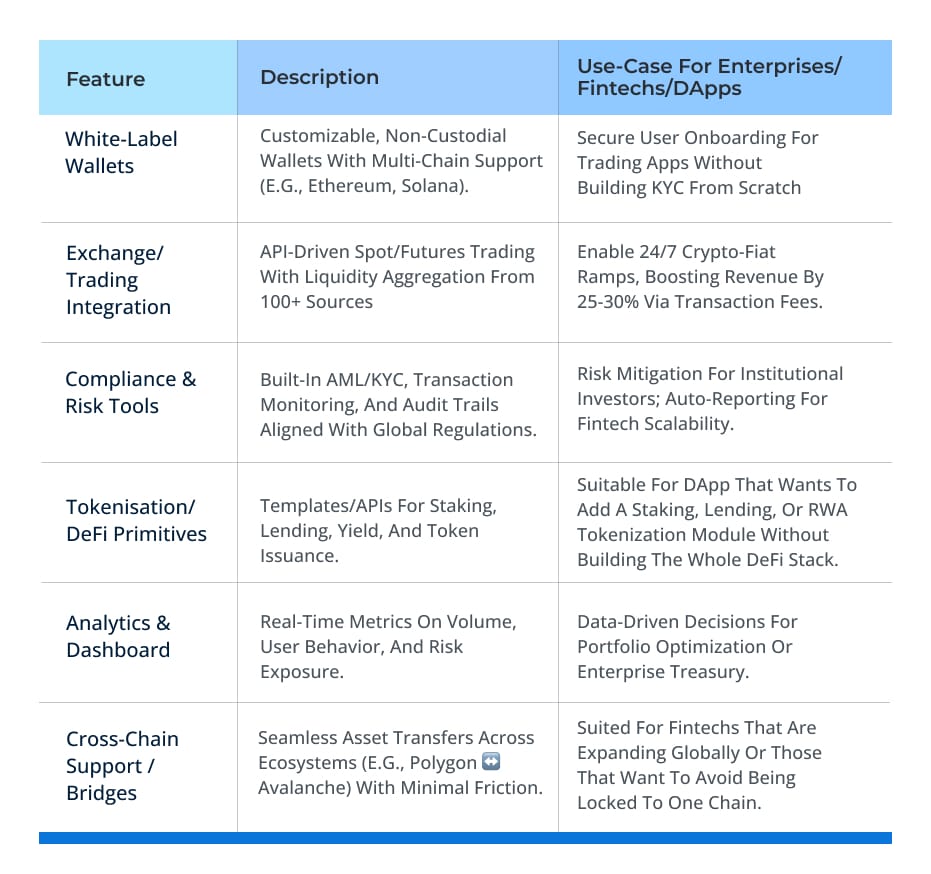
White label crypto exchange software development or CaaS solutions that offer these features ensure interoperability, speed-to-market, and multi-chain operations (across 50+ blockchains on average). However, those looking to establish their presence among top exchanges in the industry with a premium CaaS offering must check Antier’s white label exchange software features:
- High TPS and Advanced Matching Engine
- Spot Trading- Market, Limit, and Stop Limit Orders
- Automated KYC and AML
- 500+ Cryptocurrencies & Fiat Support
- External Liquidity Module
- Referral and Reward Program
- Fiat On/Off Ramp
- Enterprise-Grade Multi-cryptocurrency Wallet
- Advance Admin Back Office
- Advance Chart Tools
- Crypto Swapping
- Multichain Support
- Margin Spot Trading
- Derivatives/ Perpetual Futures Trading
- Automated Market Making Bot
- Multi Lingual
- Customer Support Chat
- News and Announcements
- Peer to Peer Trading
- Grid Trading
- Social/Copy Trading
- Multi Access Role
- Fiat Trading Pairs
- Native/Utility Token
- VIP Accounts
- Staking Module
- Launchpad
What are the Benefits of Launching Your Exchange With Crypto-as-a-Service in 2026?
BNY Mellon, Goldman Sachs, Standard Chartered, Deutsche Bank, DBS Bank, U.S Bank, and many TradFi institutions have already launched their crypto services, and many other institutions are in their transition phase. Don’t believe it? Here’s a snapshot from a16zcrypto report demonstrating the largest institutions that have embraced crypto so far.
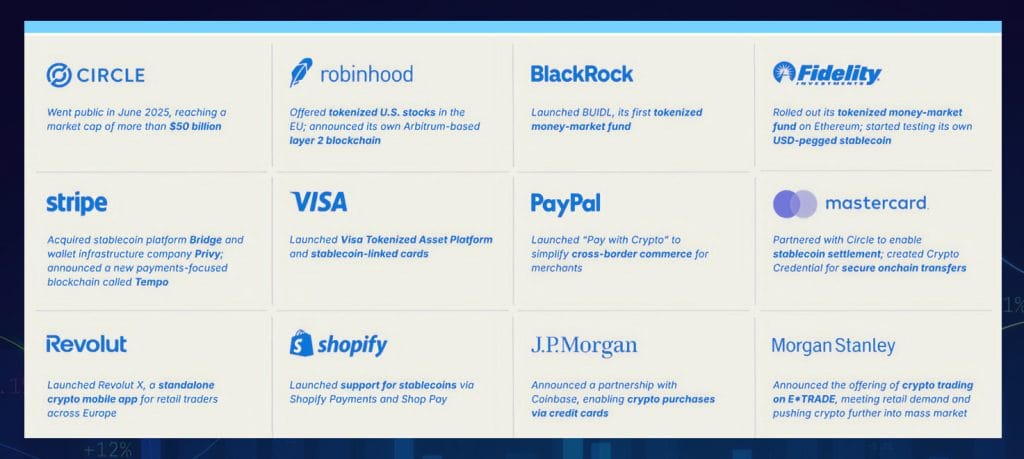
One of the reasons why businesses must pivot to CaaS for cryptocurrency exchange development is that it addresses pain points like high development costs and security risks.
- Cost and Time Efficiency: Rather than building from scratch, a business can plug into a CaaS provider and slash development expenses by 70%. Enterprises can avoid $1-1.5m in upfront infrastructure costs and redirect those funds to upgrades, marketing, and R&D.
- Scalability & Speed: With ready-to-launch white label crypto exchange infrastructure, you can launch in weeks, not months. As per Coinbase, clients achieve 10x transaction throughput via CaaS APIs, which is ideal for fintechs handling Black Friday surges in crypto volumes.
- Enhanced Security and Compliance: A reputable white label cryptocurrency exchange development company embeds security mechanisms like cold storage, MFA, wallet security, etc., and SOC 2 compliance, reducing breach risks.
- Revenue Streams: Businesses can unlock fees from trading fees, wallet fees, staking modules, token issuance, etc. Fintechs report 15-25% YoY revenue growth post CaaS integration.
- Global Reach: CaaS solutions from the best white label crypto exchange software development companies offer infrastructure for global scale that enables instant settlements in 100+ countries. It makes these SaaS solutions perfect for enterprises expanding into emerging markets like APAC, where crypto adoption is soaring.
With clearer regulatory frameworks like the EU’s MiCA and U.S. SEC guidelines, most enterprises are planning crypto pilots. Also, as per Gartner’s report, more than 40% of Fortune 500 firms are using blockchain development for supply chains or payments. So, now is the time to launch your crypto exchange software leveraging a top-notch CaaS offering.
Top Crypto-as-a-Service Providers in 2026
With dozens of players, selection hinges on customization, liquidity, and support. Here’s a list of leading CaaS providers that those seeking crypto exchange software development can count on:
- Antier: Antier offers a white label crypto exchange superapp development solution with the best features (as mentioned above). The leading white label exchange provider offers you complete control over the front-end and also lets you tweak the front-end during the development phase. Prominent features of their ready-to-deploy exchange solutions include: multichain support (50+ networks), full-stack exchange with wallets, staking, bots, etc, global compliance modules, etc. With a strong legal team and comprehensive customization potential, Antier’s white label cryptocurrency exchange is highly suitable for retail exchanges, banks, and financial institutions looking to launch impeccable exchanges with full control.
Experience the best trading experience before you pick your CaaS
- Binance CaaS: The largest exchange as per volume has recently launched a CaaS offering with very deep liquidity, broad asset coverage (600+ assets), and white label front-ends.
Businesses that adopt crypto have an unfair advantage.
With @CoinbaseBiz:
→ Instant global payments with lower transaction fees and no chargebacks
→ Better reward rates (up to 4.1% APY)
→ Integration with common accounting software
→ Secure custody and trading pic.twitter.com/Kt1wmBUqZj— Coinbase 🛡️ (@coinbase) August 6, 2025
- Coinbase Business: Another leading exchange has launched its enterprise-grade crypto infrastructure that enables brokers, banks, and payment firms to launch custody, trading, and stablecoin payment rails, backed by SEC-regulated operations. It focuses on powering banks, payment providers, and corporations, not retail exchanges.
- Stratis BaaS: Stratis describes itself as a blockchain development platform built for enterprises, allowing businesses to develop, test, and deploy customised blockchains or side-chains rather than building everything from scratch. It offers solutions for token issuance and DeFi modules for gaming and NFT apps.
The CaaS Deployment Roadmap
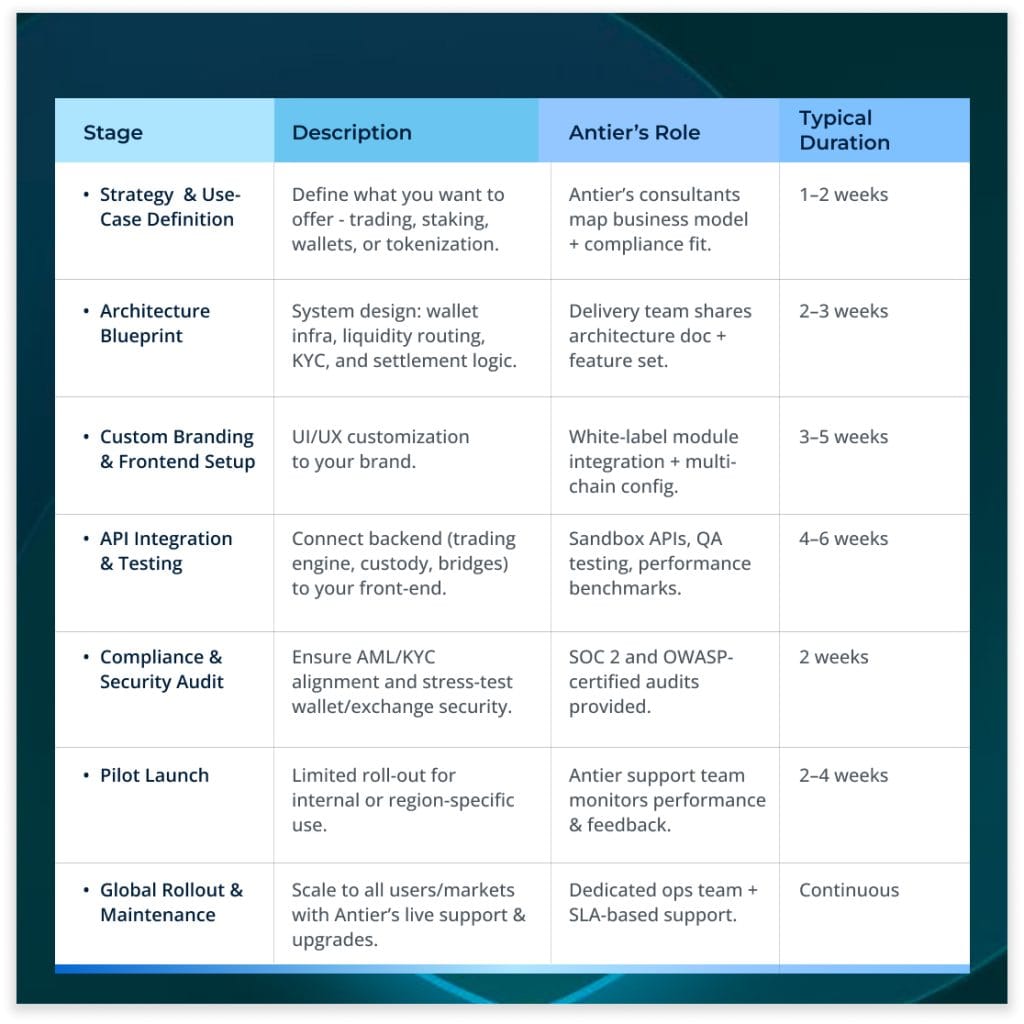
Your Next Move: Accelerate Your Expansion With CaaS
Crypto-as-a-Service is your tool to pitch the trillion-dollar crypto market. So, what should be the next step?
- For investors: CaaS infrastructure companies are high-leverage plays in the next crypto cycle. Spot those with truly end-to-end stacks, global compliance, and scalable architecture.
- For enterprises/fintechs/dApps: Don’t get stuck building from scratch. Use CaaS or white label exchange software providers to get to market fast, capture revenue, iterate UX, then scale.
- For your business roadmap: Choose a top provider like Antier and run a pilot (wallet + trading), refine UX/fees, then plan a full rollout. You must track KPIs and iterate accordingly.
Ready to act? Reach out to Antier for a free CaaS demo and strategic blueprint. Our team will help map the tech/integration timeline, cost models, and revenue potential.
Frequently Asked Questions
01. What is Crypto-as-a-Service (CaaS)?
Crypto-as-a-Service (CaaS) is a turnkey solution that allows businesses to integrate cryptocurrency functionalities such as trading, custody, and payment services without building blockchain infrastructure from scratch, using modular software that can be rebranded and launched.
02. Who can benefit from using CaaS?
CaaS is relevant for enterprises, fintech companies, dApps, and investors looking to expand into digital assets, as it enables them to integrate cryptocurrency services quickly and cost-effectively.
03. How much does it cost to implement a CaaS solution?
A premium CaaS solution can be launched for a one-time infrastructure cost starting from $50,000, significantly reducing the time and investment compared to building a solution from the ground up.


