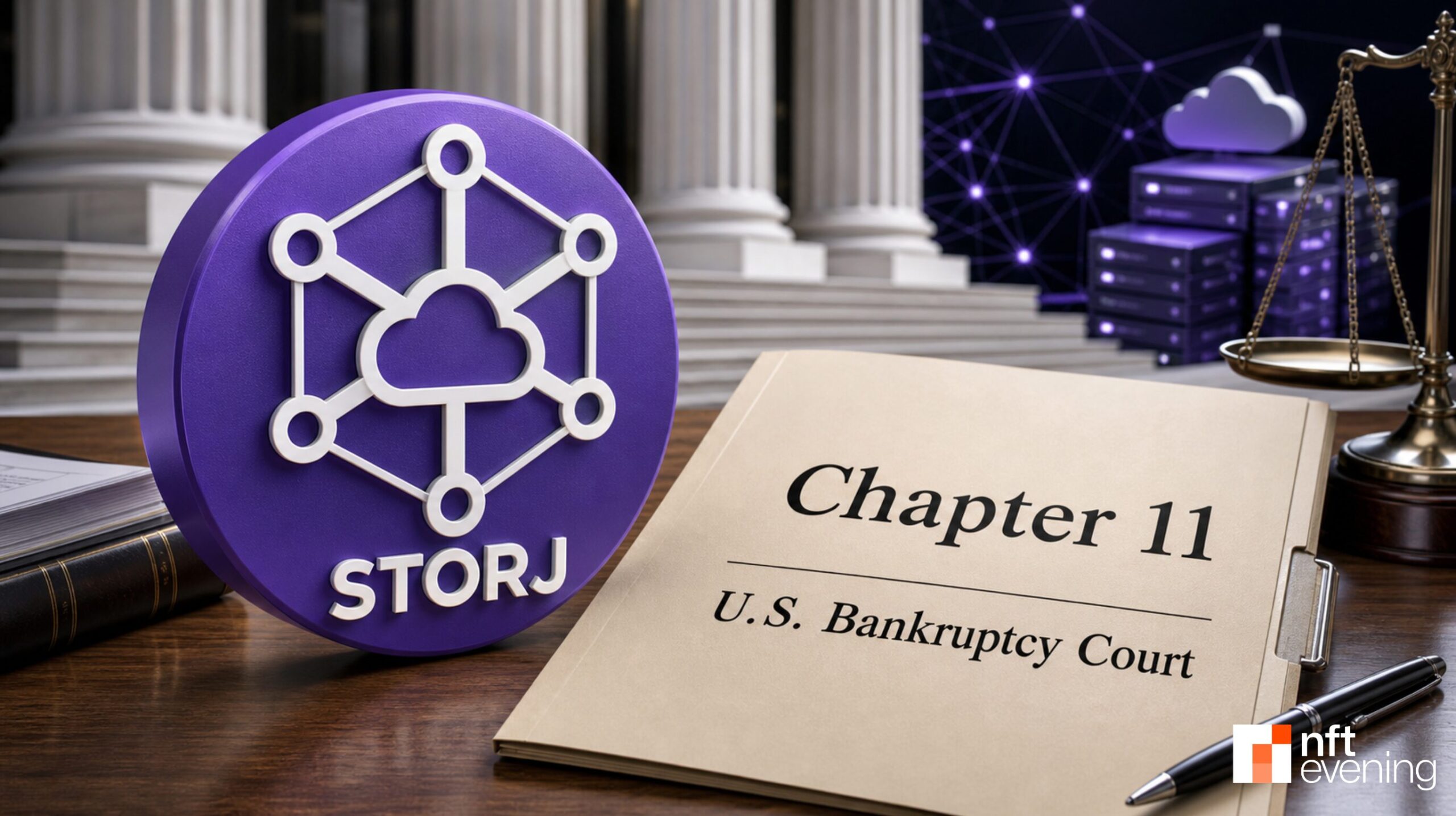
Storj Labs has entered Chapter 11 but maintains that its decentralized storage network remains operational as usual, as part of a financial restructuring to address legacy obligations. According to a press release issued by Inveniam Capital Partners via GlobeNewswire, the company filed on July 26, 2026, in the U.S. Bankruptcy Court for the Northern District of West Virginia, under case number 5:26-bk-00512.
This move places Storj in a sensitive equation for both cloud storage customers and the token community: how to handle liabilities arising from previous periods without disrupting the current network. In a July 27 statement on July 27, Storj emphasized that this is a court-supervised restructuring process, not a shutdown, and that current services, team, and commitments remain unchanged.
Today Storj began a voluntary financial restructuring — an accelerated, court-supervised reorganization to resolve legacy liabilities that predate our current strategy. The business and network continue as normal. 🧵
— Storj (@storj) July 26, 2026
Storj Files Chapter 11, Network Stays Live
Storj said it will continue operating in the ordinary course throughout the Chapter 11 process and does not expect service disruptions for customers, though steps in the process remain subject to court approval and applicable bankruptcy regulations. This is the point the company wants to clarify from the start: the restructuring filing lies at the corporate legal layer, while the storage network continues to operate as an active service.

Storj’s Chapter 11 filing. Source: U.S. Bankruptcy Court
Operational signals also match Storj’s status page. As of July 28, the Storj DCS Status page shows “All Systems Operational“, recording no incidents on July 26 and 27. Key service clusters such as AP1, EU1, and US1 are all marked as operational; 90-day uptime data shows AP1 reaching 100%, EU1 around 99.99%, and US1 around 99.98%.
Product-wise, Storj continues to operate a distributed cloud storage platform, where data is encrypted, split, and stored across a global node network rather than relying on a centralized data center cluster. According to the company’s introduction page, the Storj network spans tens of thousands of storage locations across more than 100 countries.
A Restructuring Move, Not a Shutdown
According to Storj’s announcement, current services, the network, team, and commitments remain unchanged during the restructuring process, though specific steps remain subject to customary court approvals.
Storj is using Chapter 11 as a court-supervised process to address legacy obligations. Kaloyan Raev, Director of Software Engineering at Storj, called this a “decisive” and “positive” step, stating that the underlying business remains strong and streamlined.
Chapter 11 still places Storj in a legal process with risks, but current announcements are not accompanied by any plan to halt the network. Storj stated that its object storage service is designed with 99.95% availability and “11 nines” data durability, an industry term in cloud storage used to denote an extremely low probability of data loss.
Why Storj Is Making the Move Now
Legacy liabilities are the direct reason pulling Storj into Chapter 11. These obligations arose before the current strategy, while Inveniam has continued financial support and the company has been streamlined following operational adjustments.
Chapter 11 allows Storj to consolidate legacy obligations into a court-supervised process, rather than letting them continue to weigh on the core business. This context follows Storj joining Inveniam in October 2025, which was described as aiming to accelerate innovation for data workflows and AI applications.
In the July 26 press release, Storj also placed focus on returning to its core business, unwinding past acquisitions and non-essential operations. The restructuring portion may lead to ownership changes, aiming to align management, the decentralized community, token holders, and investors, though final details remain subject to an official plan and court approval.
What’s Next for Users and STORJ Holders
For customers, Storj says current services and commitments remain unchanged during the restructuring process, though still subject to customary court approvals. For node operators, official information currently revolves around the network continuing to operate normally, with no changes announced for network operations yet.
For STORJ holders, the point to monitor is the post-restructuring ownership structure. Storj plans to propose a plan in which management, the token community, and investors share ownership of the company post-restructuring, but this mechanism has not yet been approved by the court.
STORJ dropped sharply following the Chapter 11 news. According to CoinMarketCap, as of July 28, the token is trading around $0.06088, down about 18.01% in 24 hours, with a 24-hour volume of around $24.94 million and a market cap of around $25.87 million.
The next focus will be the plan Storj files with the court, where details on legacy liabilities, Inveniam’s role, and proposed ownership for the token community will be further clarified. Until then, the project’s message remains financial restructuring while keeping the network running.