Bitcoin is being placed back at the center of the “debasement trade” by Bernstein, with a forecast that it could reach $150,000 by mid-2027, nearly double the current price range of $79,000-$80,000. This forecast comes as institutional capital returns to spot Bitcoin ETFs, U.S. national debt surpasses $40 trillion, and investors continue to seek hedge assets against currency debasement risk.
Bernstein’s Bitcoin Forecast
Bernstein is placing Bitcoin into a new bull cycle, with a base-case target of $150,000 by mid-2027. Compared to the recent $79,000-$80,000 range, this forecast implies BTC needs to gain nearly 90% in less than a year, indicating that Bernstein does not view the current recovery as merely a short-term bounce.
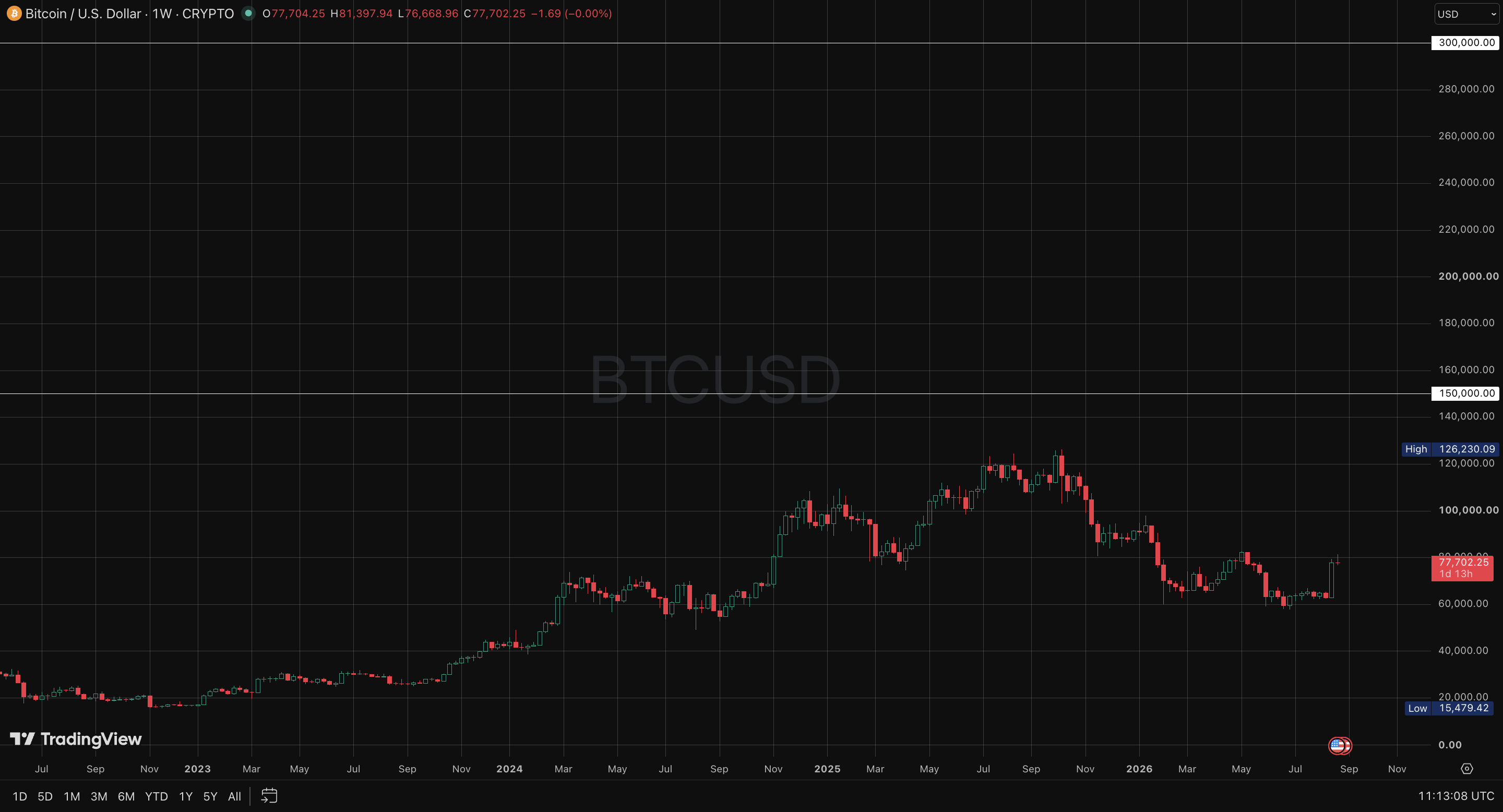
BTC Price Chart (1W). Source: TradingView
According to a client note cited by The Block, Bernstein also sets a target of $125,000 by the end of 2026 and suggests Bitcoin could reach around $300,000 at the cycle peak in 2029. In a more optimistic scenario, Bernstein presents milestones of $200,000 by mid-2027 and $500,000 by 2029, based on expectations that institutional inflows will continue to expand through the current cycle.
Why the Debasement Trade Matters
Bernstein ties the $150,000 target to the “debasement trade“, the trend where investors turn to scarce assets when concerned about fiat currency losing purchasing power. For Bitcoin, the core factor lies in its limited supply and the fact that the asset is becoming increasingly accessible to large institutional capital.
U.S. national debt surpassed $40 trillion in August 2026, according to the U.S. Treasury’s “Debt to the Penny” data. Debt pressures and budget deficits have drawn increased attention to scarce assets. Gold remains a traditional hedge, while Bitcoin is increasingly viewed by a segment of investors as a digital hard asset.
The shift is not just in how Bitcoin is labeled. Compared to previous cycles, BTC now has a deeper derivatives market, better custody infrastructure, and regulated products that make access easier for institutional investors. This moves the “debasement trade” with Bitcoin beyond just a crypto community story, allowing it to enter broader macro portfolios.
ETF Demand and Supply Dynamics
Spot Bitcoin ETFs represent the clearest channel showing institutional capital returning to the market. According to Farside Investors, U.S. Bitcoin ETFs recorded multiple large inflow sessions in August 2026, including $606.3 million on August 20, $337.6 million on August 24, and $314.3 million on August 25.
This capital flow is significant because it integrates Bitcoin into investment channels that are more familiar to institutions, wealth managers, and traditional investors. Instead of having to directly custody BTC or trade on crypto exchanges, they can access the asset through regulated products in brokerage accounts.
Following the most recent halving in April 2024, Bitcoin’s block reward dropped from 6.25 BTC to 3.125 BTC, cutting the daily issuance of new coins by more than half compared to the previous cycle. Bernstein also noted that approximately 59% of the Bitcoin supply has not moved in 12 months, indicating that the volume of coins held by long-term holders remains substantial.
This setup means new capital flowing through ETFs can exert a greater impact on price if the supply of BTC available for sale does not increase proportionally. However, ETF flows can still reverse quickly when the market experiences volatility. Following the previous streak of strong inflows, Farside recorded a preliminary outflow session of approximately $168.5 million on August 28.
Risks to the $150K Call
Bernstein’s forecast remains heavily dependent on whether ETF inflows can maintain their current momentum. Although Bitcoin has rallied strongly, the asset still typically reacts quickly to changes in liquidity, interest rate expectations, and risk appetite. If bond yields rebound or the U.S. dollar strengthens, profit-taking pressure could materialize faster.
Bernstein maintains a positive stance on Strategy, a company holding approximately 840,447 BTC, equivalent to nearly 4% of the total Bitcoin supply but analysts have lowered their price target for Strategy stock from $450 to $350. This indicates that while the market may remain bullish on BTC, it is exercising more caution regarding entities using leverage or capital issuance to accumulate Bitcoin.
Following its recent rally, Bitcoin still needs to sustain buying pressure around the $80,000 region. If ETF capital weakens or the market shifts back to a risk-off stance, reaching the $150,000 target will become more difficult within Bernstein’s projected timeline. Conversely, if ETF inflows recover and BTC holds its current price zone, Bernstein’s forecast will gain further support from real capital flows.