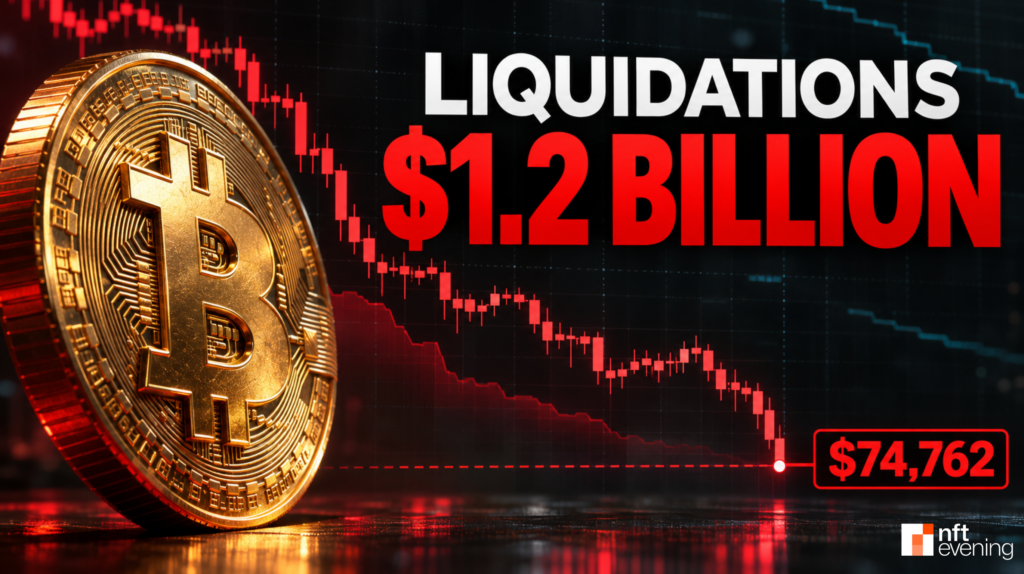
Bitcoin fell below $76,000 late in the U.S. trading session on November 5 and briefly dropped below $75,000, its lowest level in about seven weeks, as a tech stock sell-off spilled into the digital asset market. More than $1.2 billion in crypto derivative positions were liquidated in 24 hours, according to CoinGlass data.
Bitcoin later stabilized around $76,000 after losing more than 5% in the sell-off. Spot Bitcoin ETFs in the U.S. continued to record net outflows, while stronger-than-expected jobs data pushed Treasury yields higher.

BTC Price Chart (4H). Source: TradingView
Leveraged Longs Take the Brunt
In the 24 hours leading up to the morning of November 6, CoinGlass recorded $1.24 billion in position liquidations involving 235,397 traders. Long positions accounted for $1.10 billion, or 88.8% of the total value, indicating liquidation activity was concentrated among those betting prices would rise.

24-hour liquidation data. Source: CoinGlass.
Bitcoin accounted for $326.64 million in liquidations, with 89.8% coming from long positions. Ether followed with $209.25 million and a long ratio of 84.6%. Binance accounted for 45.4% of total liquidations across tracked platforms, while the largest single order was an ETHUSDT long position worth $10.94 million.
Bitcoin was trading above $80,000 before reversing down to around $75,200. The sharp drop of more than 6% in a short period quickly put pressure on highly leveraged long positions.
Exchanges automatically close positions when collateral no longer meets requirements. When multiple liquidation levels are clustered close together, mandatory sell orders can drag prices down and trigger additional positions. The numbers show that leverage amplified the decline, but do not prove that liquidations caused the sell-off.
Tech Rout Spills Into Crypto
Bitcoin’s decline accelerated during the U.S. trading session on November 5 as a sharp sell-off swept Wall Street. The Nasdaq Composite fell 5.5%, the S&P 500 lost 4.4%, and the Dow Jones Industrial Average dropped 1,833 points, or 3.4%. This was the sharpest single-day decline for the S&P 500 since April 2025.
Stocks related to artificial intelligence and data center infrastructure suffered the heaviest damage. Nvidia dropped 9.3%, AMD lost 17.3%, while the Philadelphia Semiconductor Index plunged by about 12%. The Nasdaq closed 11.9% lower than its peak set last month, crossing the 10% threshold commonly used to define a correction.
The sell-off occurred against the backdrop of investor concerns over high borrowing costs, AI stock valuations, and the potential slowdown in data center construction. The U.S. midterm election results added further uncertainty, as some infrastructure projects could face increased opposition.
Bitcoin dropped below $76,000 during the same session, while Ether fell below $2,250 at one point. Gold moved in the opposite direction, rising about 0.6% to nearly $4,094 per ounce.
ETF Outflows Signal Weak Spot Demand
U.S. spot Bitcoin ETFs saw net outflows of $430.2 million on November 5, the largest single-day outflow since the October 30 session, according to data from Farside Investors.
Fidelity’s FBTC led with $199.9 million in outflows, followed by BlackRock’s IBIT with $105 million. These two funds accounted for nearly 71% of total outflows for the day. ARKB, EZBC, HODL, and GBTC recorded a combined $125.3 million in outflows, while other funds saw no significant changes.
A day earlier, the funds drew net inflows of $74.6 million, the first positive session since October 29. Capital flows returned to negative territory in the very next session, bringing total net outflows for the first four sessions of November to $869.8 million. Three out of four sessions recorded negative flows as Bitcoin fell back below $76,000.
Strong Jobs Data Adds Rate Pressure
The U.S. economy added 165,000 nonfarm jobs in October, well above the forecast of around 65,000, according to the U.S. Bureau of Labor Statistics. The unemployment rate fell from 4.2% to 4.1%. Average hourly earnings rose 0.4% during the month and 3.1% year-over-year.
The jobs report published on November 6 pushed U.S. Treasury yields higher. The two-year yield rose about 5 basis points to 4.52%, while the 10-year yield gained about 4 basis points to 4.88%. Stronger-than-expected job and wage growth reinforced the likelihood that interest rates will remain higher for longer.