What’s in Kalshi’s rulebook update filing, plus a look at how other prediction exchanges handled Iranian Supreme Leader markets following Khamenei’s death.
Days after sparking backlash over how it settled a high-profile geopolitical contract, Kalshi quietly filed a rulebook amendment with the Commodity Futures Trading Commission (CFTC) that formally codifies how the exchange handles markets when the primary subject dies.
The controversy centered on a Kalshi contract asking whether Iran’s Supreme Leader, Ali Khamenei, would be “out of office” by a specified date. After reports emerged that Khamenei had been killed, many traders expected the contract to resolve to “Yes,” and trading on the market continued. Kalshi eventually paused trading and later settled positions at the last traded price prior to death, citing its existing death-related carveout in the market rules.
The contract generated roughly $21.7 million in trading volume before being halted on Feb. 28.
Now, in a March 2 submission to the CFTC titled “Draft Death Caveat Rulebook Amendment,” Kalshi is amending Rule 6.3 of its exchange rulebook to explicitly authorize settlement at the “last traded price prior to the death” if “a natural person who is the primary subject of a Contract’s Underlying or Payout Criterion dies prior to Expiration.”
It further allows the exchange to halt trading if it “reasonably believes that the death of such person has occurred, is imminent, or that circumstances giving rise to the death may be occurring,” and gives Kalshi’s Outcome Review Committee authority to determine a fair settlement value if needed.
The filing does not create a new death-related rule. Kalshi says the amendment is designed to “provide additional clarity” and “memorialize” how the exchange has already been operating in such cases.
Kalshi reimburses all fees and net losses
The resolution triggered backlash from traders who believed the contract would pay out “Yes” if Khamenei died. Kalshi cofounder and CEO Tarek Mansour addressed the controversy publicly in a lengthy March 1 post on X, telling users that the death-related carveout was always posted in the rules for the market.
The carveout was not merely a disclaimer added to the market. It also appears in Kalshi’s formal product certification filed with the CFTC under the name “WLEADEROUT.”
“The market rules were not changed. The death carveout and settlement based on last-traded-price were part of the published market rules from the outset,” Mansour wrote, adding, “No trader lost money on this market.”
Mansour said Kalshi reimbursed all fees and net losses so that “no trader ended net-negative after our reimbursements,” a discretionary step that went beyond what the contract rules required.
Traders react
Not all were satisfied with Kalshi’s reimbursements, with some traders explaining and showing receipts of net losses from trades made before the market was paused.
For many, the lag time between initial rumors of Khamenei’s death and the pausing of the market was the key mistake that allowed trading activity to continue amid widespread confusion. Well-known professional trader “Domer” responded to Mansour’s X post suggesting the market should have been paused sooner, with all trades taking place between the initial attack and market pause being unwound. He also makes suggestions for more clear market framing.
Good post, but all of this (and more) should be formalized proactively instead of conjured up reactively.
In an ideal world, the contract should’ve paused immediately as the death rumors began, which was fairly quickly (tried to alert people to this in the discord).
And then… pic.twitter.com/uFQ8azijsC
— Domer❤️🔥 (@Domahhhh) March 2, 2026
As the debate unfolded on X, users also expressed frustration tied to confusion over how reimbursements were applied and reflected in user accounts. Some traders questioned whether they had in fact been made whole. Others said the credits were not immediately visible or did not match what they believed they were owed.
Kalshi product and engineering team member Rainer Sainvil responded directly to one such complaint with an explanation.
“The reimbursements were paid out as separate credits,” he wrote. “You can find them in your activity on the app/web and reflected on your portfolio. We’ll make this clearer in the future, but anyone who had a loss for any reason was made whole.”
How Polymarket handled Khamenei exit contracts
The controversy was not confined to Kalshi. Polymarket’s international platform listed a comparable contract asking whether Khamenei would be “out as Supreme Leader of Iran by February 28.” Under Polymarket’s standard event language, such markets resolve based on whether the subject “ceases to be” in office by the deadline, with outcomes determined according to “a consensus of credible reporting.”
Unlike Kalshi’s contract rules, Polymarket’s market language does not include an explicit death carveout. Death qualifies as being “out,” and the contract is designed to settle if the condition is met before the Feb. 28 cutoff.
But the phrase “consensus of credible reporting” became the focal point of dispute. According to Bloomberg, traders debated whether media reports published on Feb. 28 were sufficient to constitute consensus under the market’s stated resolution standard. Some argued that early reports of his death satisfied the requirement before the deadline. Others contended that confirmation did not reach the necessary “consensus” threshold in time.
An initial outcome was proposed on the platform, but the resolution has entered dispute cycles as token holders vote on whether the reporting standard had been met.
Because Polymarket operates offshore and is not under CFTC oversight, it is not subject to the same market self-certification framework or core principles that govern U.S. exchanges like Kalshi. That structure allows Polymarket to offer contracts in which death may directly determine the outcome under the contract’s terms, without a separate death-specific settlement rule.
What other U.S.-accessible platforms did with Khamenei markets
Beyond Kalshi, most major retail prediction platforms available in the U.S. did not offer comparable contracts tied directly to whether Iran’s Supreme Leader would leave office. Event contract trading platforms operated by Crypto.com, DraftKings, and FanDuel, among others, did not appear to list a leader-specific contract tied to Khamenei’s status.
But a small number of platforms other than Kalshi did offer markets tied to the Iranian Supreme Leader.
Gemini’s “remain” contract
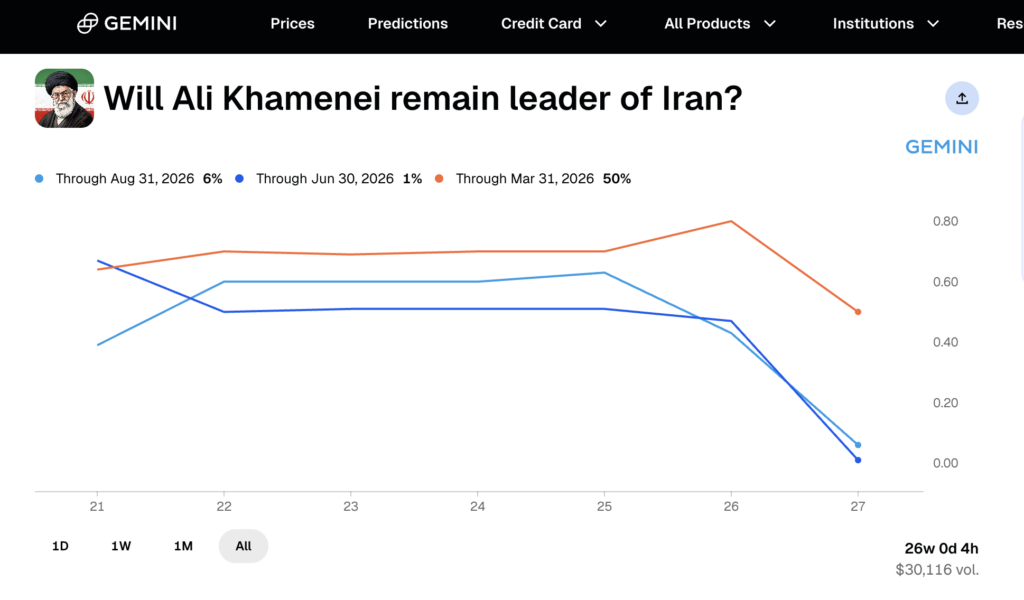
One notable U.S.-regulated exception was Gemini’s CFTC-regulated Predictions platform, which offered a market asking whether Ali Khamenei would remain Supreme Leader through specified future dates.
Unlike Kalshi’s “out” framing, which placed an explicit death carveout in its contract rules, Gemini structured the contract around continuity. The market resolved to “Yes” if Khamenei remained in office through the stated date and “No” if he did not. Publicly visible listings show contracts beginning with “remain through March 31, 2026,” and extending to later dates. There was no publicly visible “remain through Feb. 28” version at the time of review.
After reports of Khamenei’s death surfaced on Feb. 28, the listed “remain” contracts resolved to “No,” reflecting that he did not continue in office through those deadlines. In contrast with Kalshi’s structural design, Gemini’s contract treated death as one of several possible ways the leader could cease to remain in office, without isolating it as a separate settlement category.
PredictIt’s no-action framework
PredictIt presents a different regulatory model. Unlike Kalshi or Gemini, while accessible to U.S. users, PredictIt does not operate as a designated contract market (DCM). Instead, it functions under a 2014 CFTC no-action letter, allowing limited real-money political event contracts for academic research purposes, subject to position caps and other restrictions.
PredictIt’s parent company, Aristotle, has separately received CFTC approval to operate a DCM through Aristotle Exchange. That approval does not apply to PredictIt, which continues to operate under the no-action framework.
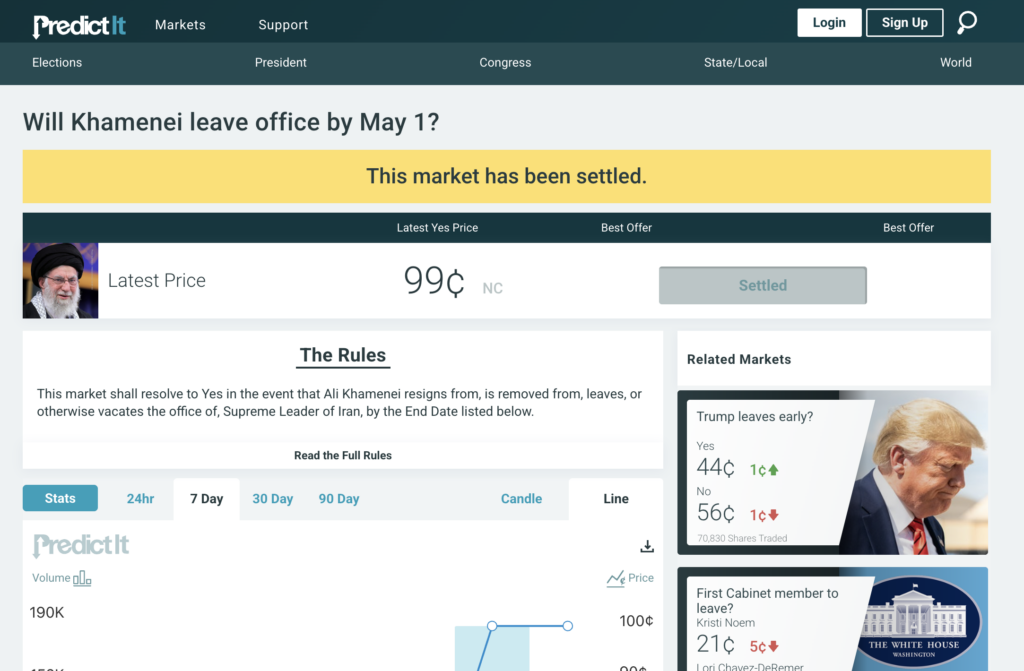
PredictIt listed a market asking whether Khamenei would “resign from, be removed from, leave, or otherwise vacate” office by May 1. Under the contract’s language, death would fall within the definition of vacating office, creating a straightforward binary payout if the event occurred before the deadline.
Following reports of Khamenei’s death, the May 1 contract resolved to “Yes,” as the deadline had not yet passed.
A broader regulatory question
The Khamenei episode has sharpened attention on how prediction markets handle contracts tied to geopolitical instability and political leadership. Iran-related contracts drew criticism from some lawmakers and policy observers who argue that certain event markets risk appearing to profit from armed conflict or political violence.
Under the Commodity Exchange Act, the CFTC has authority to prohibit event contracts involving terrorism, assassination, war, gaming, or activities deemed contrary to the public interest. That language gives regulators discretion over geopolitically sensitive contracts, even when the mechanics differ across platforms.
In that context, the mechanics of settlement, not just the existence of the contract, take on added significance.
Kalshi has now codified in its core rulebook that when the primary subject of a contract dies, the exchange may settle at the last traded price. The framework is designed to prevent the market from being construed as a “death market.”
By contrast, Gemini’s “remain in office” contract and PredictIt’s “leave office by May 1” market treated death as one of several pathways by which a leader could cease to hold office, without isolating it as a separate settlement category. Those markets resolved according to their stated definitions, but without the additional structural separation Kalshi has now embedded in its rules.
For traders, the lesson may be simple: Read all of the rules before placing a trade. For regulators, the harder question remains: Where is the line between political forecasting and war-linked speculation, and who ultimately draws it?

Mike Breen
Mike Breen has been a professional writer and editor covering a wide range of topics for more than 30 years. He’s been a freelance gaming industry writer since 2020, reporting on sports betting, online casinos, and more for various Catena Media sites, and he began reporting on prediction market industry news in 2025 for Prediction News. Prior to that, Mike was a founding editor at his hometown altweekly newspaper in Cincinnati, Ohio, where he extensively covered local arts, music and news.Mike’s published writing has received recognition and several awards from organizations like the Society of Professional Journalists and the Association of Alternative Newsmedia.When Mike is not working, he enjoys playing and listening to music, attending comedy shows, watching movies, and spending time with his family and three cats.


