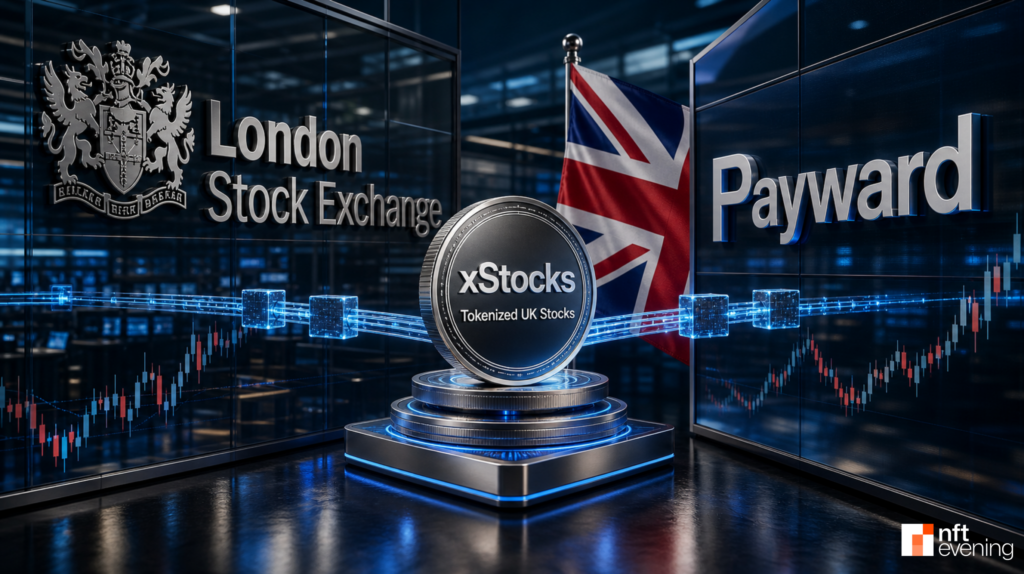
London Stock Exchange Group (LSEG) and Payward, the parent company of Kraken, announced a partnership on Sept. 1 to bring London-listed stocks onto tokenized infrastructure, aiming to allow xStocks products to trade on LSE 24 in 2027, subject to regulatory approval.
The agreement pushes the London Stock Exchange deeper into the tokenized equities race as traditional exchanges and crypto firms alike seek to expand stock trading beyond current market hours. The plan also highlights how tokenization is gradually shifting from crypto-native platforms to regulated market infrastructure.
Inside the LSE-Payward Plan
According to LSEG’s announcement, the London Stock Exchange is developing a tokenized equity structure for the UK market and has selected Payward as its initial partner. Payward stated it will begin tokenizing the top 100 London-listed companies in the coming weeks under its xStocks brand.
xStocks are tokens designed to represent underlying shares on a 1:1 basis. Each token is backed by actual shares or equivalent assets, aimed at giving investors exposure to traditional equities via blockchain infrastructure.
If approved, LSE plans to support trading of xStocks on LSE 24, a 24/5 venue the exchange is developing. Notably, the plan ties xStocks to an LSE-developed trading venue rather than relying solely on crypto-native channels.
A Push Into Tokenized Equities
Tokenized equities are emerging as a new battleground among crypto exchanges, fintech brokers, and traditional market institutions. These products are promoted as a way to extend equity trading beyond traditional market hours, shorten settlement cycles, and allow assets to move more fluidly across digital platforms.
Payward noted that xStocks are currently available in over 110 countries, but are not available to UK-based investors and excluded for U.S. persons. The company also disclosed that xStocks has recorded over $40 billion in total volume, over $20 billion in on-chain settled volume, and more than 200,000 holders. This scale moves xStocks beyond a minor experiment, though the market remains early and heavily dependent on regional regulatory boundaries.
Payward and the London Stock Exchange are partnering to advance the tokenization of UK equity markets.
In the coming weeks, the 100 largest London-listed equities will go live as xStocks, bringing 24/7, programmable onchain access to investors in more than 110 countries.…
— Payward (@Payward) September 1, 2026
For Kraken and Payward, xStocks helps expand operations from crypto spot trading into traditional assets. Payward describes itself as the multi-asset financial infrastructure behind Kraken, NinjaTrader, CF Benchmarks, and xStocks. Partnering with LSE brings the product closer to traditional market infrastructure rather than circulating exclusively within crypto-native channels.
London’s Market Context
The LSE-Payward plan comes as London’s capital markets continue working to regain momentum after years of pressure from New York and other major listing hubs. Several major companies have chosen or considered U.S. listings, while UK IPO activity has yet to return to former highs.
According to EY data, the UK IPO market recorded 7 deals raising approximately £577 million in the first half of 2026. While an improvement over previous lulls, the figures show London’s recovery remains cautious.
LSEG has also been expanding its role from a traditional exchange operator into a broader market data, infrastructure, and technology group. In FY 2025, LSEG posted total income of approximately £9.0 billion and adjusted EBITDA of around £4.5 billion. The partnership with Payward also follows the UK’s broader push to build tokenized market infrastructure, including a recent UK tokenization taskforce backed by more than 50 firms.
The Regulatory Question
Plans to list xStocks on LSE 24 remain subject to regulatory approval. In the UK, digital securities projects are being tested under the Digital Securities Sandbox overseen by the FCA and the Bank of England, a program set to run through December 2028.
Tokenized equities do not automatically grant the full suite of rights attached to traditional shares. While investors can gain price exposure, shareholder features such as voting rights, dividend distributions, legal recourse, and dispute mechanisms depend on the legal structure of each specific product.
The World Federation of Exchanges previously warned that stock-like tokens could cause confusion if they lack matching legal rights. For LSE, key considerations are likely to include 1:1 backing, custody arrangements, the underlying shareholding entity, and how economic benefits pass through to token holders.
Timeline to Watch
Between now and the end of 2026, the first key milestone to watch will be the specific list of 100 London-listed stocks that Payward plans to tokenize. The selection will indicate whether the initial rollout focuses purely on highly liquid blue chips or extends to equities with broader international demand.
By late 2026, LSE 24 is slated to enter client testing. If all goes according to plan, the venue will launch with ETPs in the first half of 2027, before tokenized equity structures like xStocks can be considered for trading on the platform.
In 2027, regulatory approval will be the decisive hurdle. If cleared, LSE could become one of the first traditional stock exchanges in Europe to bring tokenized public equities onto a fully regulated trading venue.