World Liberty Financial, a crypto project tied to President Donald Trump’s family, has received conditional approval from the U.S. Office of the Comptroller of the Currency (OCC) to establish World Liberty Trust Company, N.A., a national trust bank designed to issue the USD1 stablecoin and provide digital asset custody services under federal supervision.
The decision, issued by the OCC on August 14, brings World Liberty closer to its goal of turning USD1 into a federally regulated stablecoin infrastructure. However, this is not yet the final operating license: the company must still meet the OCC’s pre-opening requirements before the trust bank can officially begin operations.
What OCC Approved
According to the OCC decision, the agency has granted preliminary conditional approval to World Liberty Trust Company, N.A., a national trust bank expected to be located in Bay Harbor Islands, Florida. The company will be owned by WLTC Holdings LLC and organized as a trust bank, rather than a traditional deposit-taking commercial bank.
The scope of activities approved by the OCC focuses on USD1 and digital asset custody. World Liberty Trust is designed to issue and redeem USD1, maintain backing reserves for the stablecoin, provide digital asset custody services under a fiduciary model, and support conversions between USD1 and other digital assets for custody clients.
Even so, the OCC has not yet granted final approval. World Liberty must still meet pre-opening conditions before the trust bank can officially operate, including requirements for capital, liquidity, governance, risk control, and compliance.
Why It Matters For USD1
USD1 is the core of World Liberty’s stablecoin strategy. The token is designed to maintain a 1:1 peg to USD, supporting payments, digital asset trading, and on-chain financial use cases.
According to CoinGecko data around the time of the OCC decision, USD1 had a circulating supply of approximately 4 billion tokens and a market capitalization of nearly $4 billion. This scale places USD1 among the major stablecoins by market cap, though it remains far behind the top two leaders, USDT and USDC. The total stablecoin market capitalization currently stands at around $310 billion.
This move by the OCC helps World Liberty reinforce the narrative that USD1 is not merely a Trump-branded stablecoin, but can operate on federally supervised infrastructure. For a token that has reached a scale of around $4 billion, this layer of credibility is an important factor if World Liberty wants to bring USD1 into larger payment and custody flows.
OCC filings show that World Liberty Trust expects to assume the roles of issuer, custodian, and reserve maintainer for USD1 from BitGo Bank & Trust if the chartering process is completed. That would bring many core links of USD1 directly under World Liberty, from token issuance and redemption to reserve management.
World Liberty’s Bigger Play
World Liberty does not view this decision as an isolated licensing procedure. Following the OCC decision, Zak Folkman, co-founder and COO of World Liberty Financial, called this a “major milestone” for WLFI, while CEO Zach Witkoff said World Liberty Trust is designed to issue USD1 and provide custody under federal supervision.
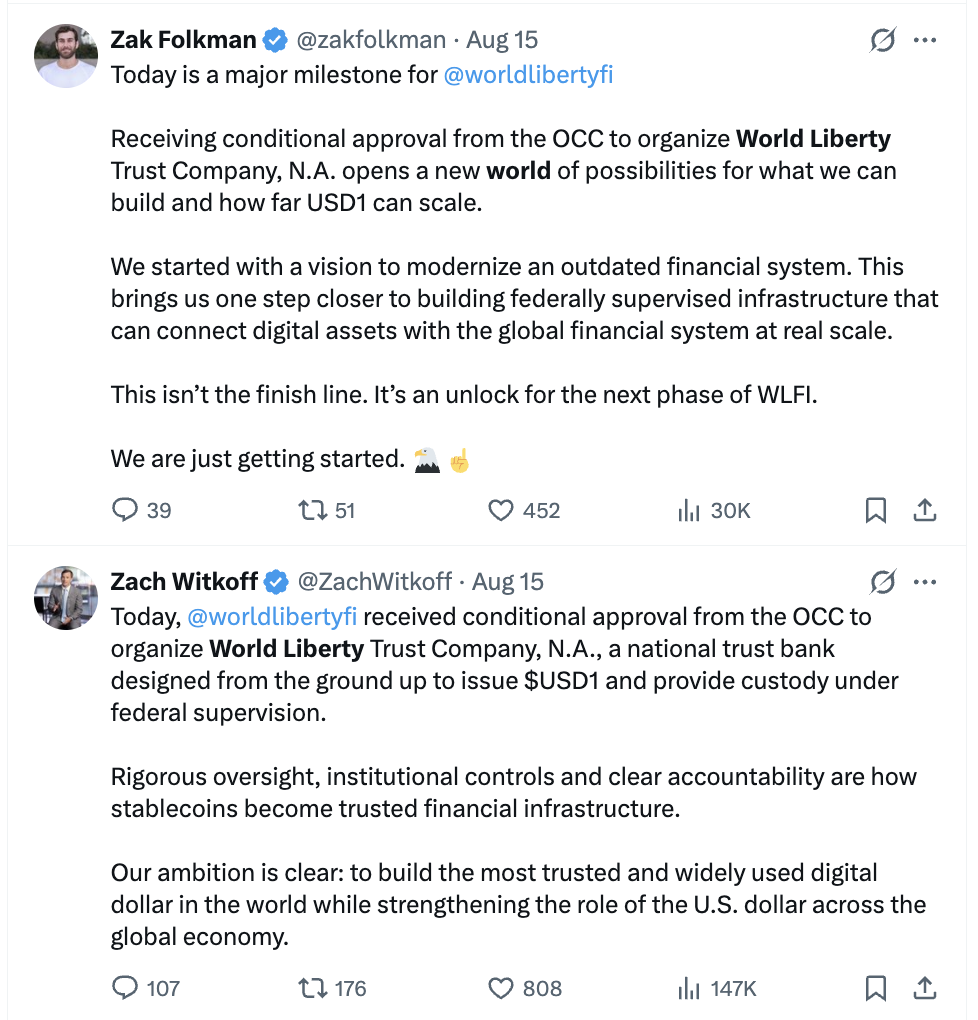
Posts by Zak Folkman and Zach Witkoff following the OCC decision. Source: X
Both frame this approval within the story of expanding USD1 from a crypto-native stablecoin into supervised financial infrastructure. That positioning is critical for World Liberty as USD1 has reached a scale of around $4 billion, but still needs to prove its operational capability, reserve management, and compliance if it wants to move beyond the initial group of crypto users.
The Trump-Linked Scrutiny
The connection to the Trump family is the reason World Liberty’s application attracted scrutiny beyond the scope of an ordinary charter application. In its decision filing, the OCC stated that it received 7 comment letters from 4 commenters, which raised concerns regarding conflicts of interest, the role of the Trump family, political ties, and the potential for favorable treatment during the review process.
The OCC responded that the application was evaluated through standard procedures by technical career staff, and that several issues raised in the comment letters fall outside the scope of review for a charter application. The agency also emphasized that the approval is conditional and does not exempt World Liberty from supervisory and compliance requirements.
If World Liberty Trust is granted final approval, this case will become a notable example in the implementation of US stablecoin legislation, as an issuer with direct political ties seeks entry into the federal banking framework just as the stablecoin market begins to be regulated more tightly.
What Comes Next
Following the August 14 approval, World Liberty must still go through the pre-opening phase before World Liberty Trust can operate. The OCC requires the company to have a minimum of $20 million in Tier 1 capital, maintain liquid assets sufficient to cover at least 180 days of operating expenses, and finalize governance staffing, internal controls, custody policies, reserve management procedures, and BSA/AML and OFAC compliance programs.
The OCC stated that the decision may expire if World Liberty fails to raise adequate capital within 12 months, or if World Liberty Trust does not open for business within 18 months from the date of preliminary approval.
World Liberty’s application will continue to be monitored as the OCC implements regulations under the GENIUS Act, the stablecoin law enacted by the US in July 2025. For USD1, the primary questions remain whether World Liberty will receive final approval, maintain reserve transparency as it expands supply, and meet the OCC’s real-world supervisory oversight.
If it satisfies these conditions, World Liberty will move closer to its goal of bringing USD1 into federal banking infrastructure. If not, the August 14 approval remains merely a conditional approval, not a license for the trust bank to operate.