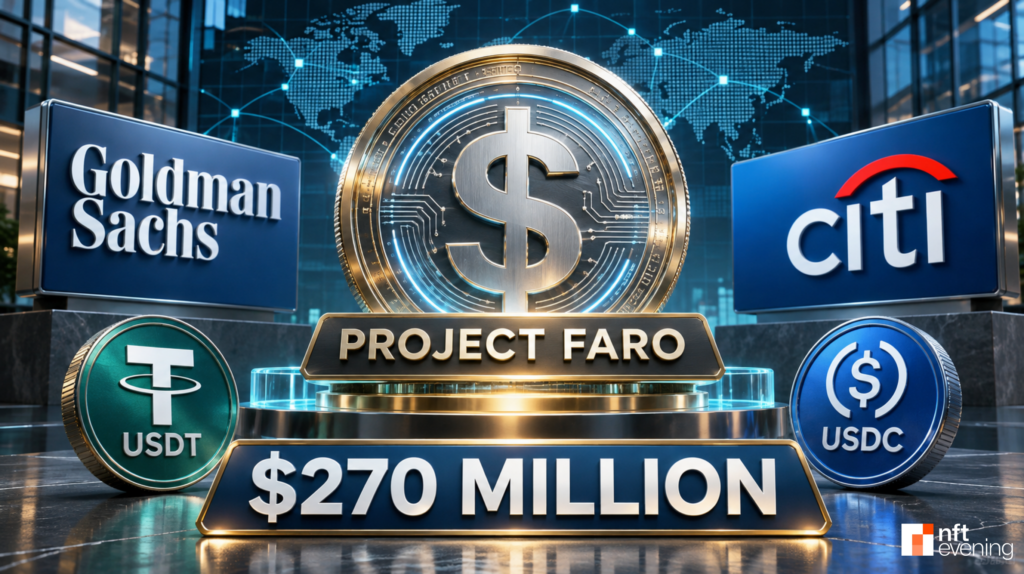
Goldman Sachs, Citigroup, and other members of the group of 21 financial institutions behind Project Faro have reportedly committed approximately $270 million to cover five years of operations for a U.S.-bound stablecoin issuer, Bloomberg reported on Nov. 10, citing people familiar with the matter. The project aims to issue a USD-pegged stablecoin for cross-border payments and digital asset settlement in the first half of 2027.
The reported capital commitment brings Project Faro closer to its launch phase, as traditional financial institutions seek to build their own digital payment infrastructure in the nearly $290 billion stablecoin market.
$270 Million to Fund Five Years of Operations
Bloomberg did not disclose the disbursement schedule, contribution amounts, or individual members’ ownership stakes. The $270 million reportedly covers five years of operating expenses for the new company, but there is no indication that the 21 institutions will contribute equally or hold equivalent roles in the joint venture.
This operating capital is separate from the backing assets for the stablecoin. Project Faro has not announced its budget allocation or reserve structure.
“Project Faro” is currently an internal name, not the official name of the company or the stablecoin. According to Bloomberg, the company is expected to be incorporated in the U.S. and is actively recruiting a chief executive officer. Goldman Sachs and Citi referred questions to project representatives, while a spokesperson for Project Faro declined to comment.
Twenty-One Institutions Target a 2027 Launch
Project Faro originated from an initiative announced by 10 banks in October 2025 to study a 1:1 backed digital currency for use on public blockchains. On Sept. 1, 2026, a group of 21 financial institutions committed to establishing a new company in the second half of the year, subject to closing conditions, with the goal of bringing its first stablecoin to market in the first half of 2027.
The ten North American members include Bank of America, Capital One, Citi, Fidelity Investments, Goldman Sachs, PNC Financial Services, Scotiabank, TD Bank Group, Wells Fargo, and WisdomTree. The eight European members are Santander, BBVA, Commerzbank, Crédit Agricole, Deutsche Bank, Lloyds Banking Group, Rabobank, and UBS. The remaining three institutions are Japan’s MUFG Bank, the United Arab Emirates’ Sirius International Holding, and South Africa’s Standard Bank.
The initial product is expected to be a USD-pegged stablecoin catering to wholesale, institutional, and retail markets. Applications highlighted by the group include cross-border payments and digital asset settlement. In the long term, the joint venture plans to issue stablecoins pegged to other G7 currencies, with the euro prioritized next.
Bank-Led Stablecoin Projects Gain Ground
Project Faro is one of several stablecoin initiatives being deployed by traditional financial institutions. In Europe, Qivalis is backed by 37 banks across 15 countries and received an Electronic Money Institution (EMI) license from the Dutch Central Bank in October. The company plans to issue a euro stablecoin after completing the remaining MiCA requirements and publishing a white paper.
BBVA and Rabobank participate in both Project Faro and Qivalis. Faro prioritizes a USD stablecoin before expanding to the euro. Qivalis focuses on a euro token serving on-chain payments and settlement. The company has not yet issued cryptocurrency or offered payment services to the public.
Another coalition is Open Standard, backed by more than 100 enterprises including Visa, Stripe, and Mastercard. This coalition launched Open USD in late September. The token currently has approximately $933 million in circulation, according to DefiLlama.
Faro Enters a Market Dominated by USDT and USDC
Project Faro is set to enter a highly concentrated market. DefiLlama data on Nov. 11, 2026, shows total stablecoin market capitalization at approximately $287.28 billion. Tether’s USDT accounts for $175.75 billion, representing 61.18% of the market. Circle’s USDC ranks second with approximately $70.14 billion.

Stablecoin by Market Cap: Source: DefiLlama
The two largest stablecoins have a combined circulating value of approximately $245.89 billion, accounting for 85.59% of the market. Project Faro has not yet issued a token, so it has no circulating supply or secondary market liquidity. The project has also not disclosed its deployment blockchain, listing plans, liquidity partners, or redemption mechanism.
Licensing and Product Details Remain Outstanding
Project Faro’s target launch in the first half of 2027 comes shortly after the new U.S. stablecoin regulatory framework takes effect. The GENIUS Act enters into force on Jan. 18, 2027. From that point on, payment stablecoin issuers in the U.S. will generally be required to hold appropriate federal or state licenses.
The September announcement stated that the initiative aims to comply with the GENIUS Act and the European Union’s Markets in Crypto-Assets framework upon implementation. The group has not yet announced its regulatory supervisor, licensing roadmap, or the specific legal entity responsible for issuing and redeeming tokens.
Project Faro has also not announced the stablecoin’s name and ticker, deployment blockchain, custodian, reserve structure, reserve attestation provider, fee schedule, or redemption terms. Ahead of its target launch in the first half of 2027, the project still needs to complete its corporate incorporation, appoint a CEO, and establish a regulatory roadmap for the product.